
LIPOSOMAL VITAMINS C & E
The antioxidant partnership.
Vitamin C and vitamin E are the skin’s two great antioxidants — one water-soluble, one oil-soluble — and together they form one of the best-known partnerships in skin biology.
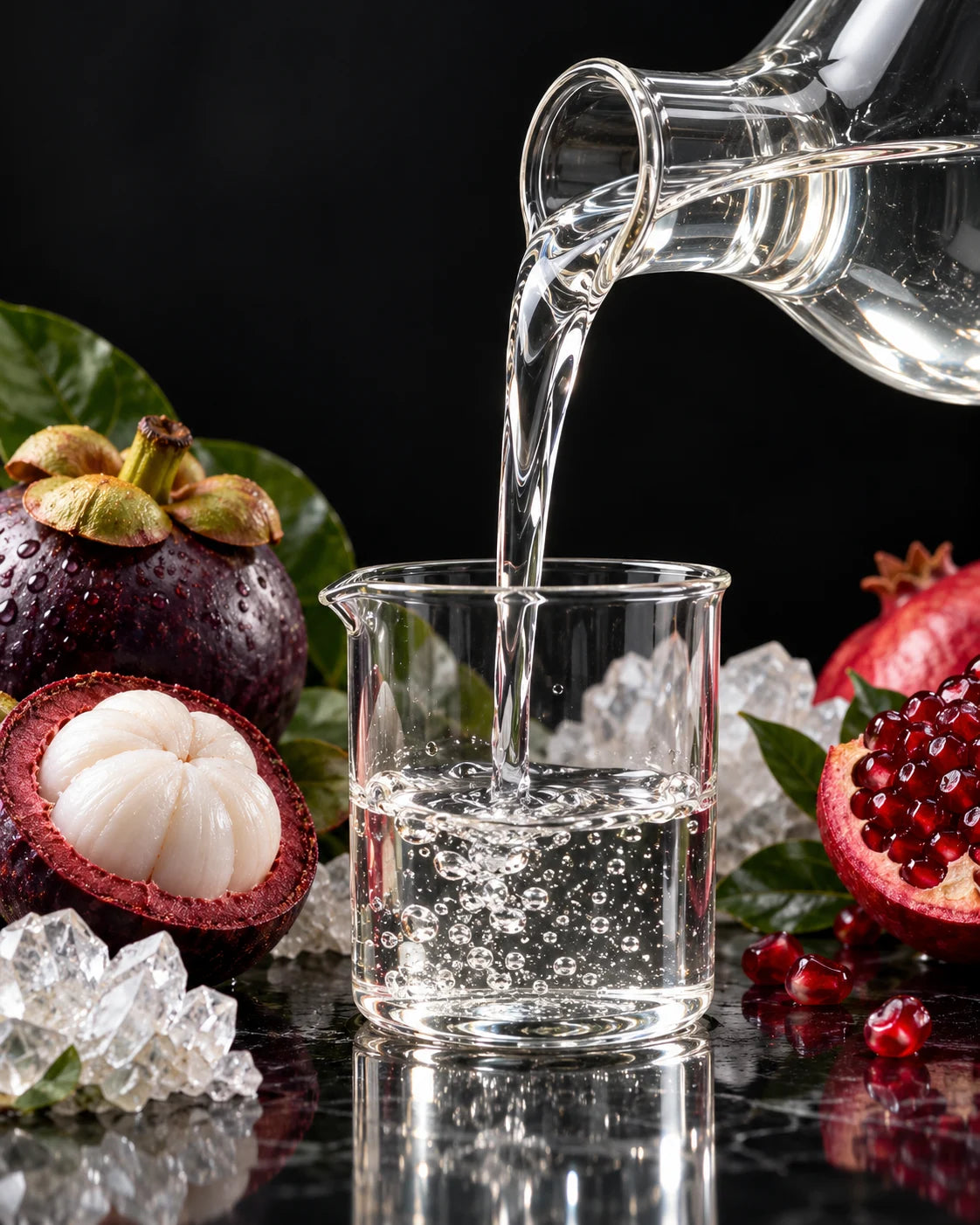
ULTIMATE and MUSCLE-AID both carry liposomal vitamin C and liposomal vitamin E. Vitamin C is essential for collagen, the protein that gives skin and connective tissue their strength. Vitamin E protects cell membranes and helps keep the balm’s natural oils fresh.
Liposomal vitamin C · liposomal vitamin E
In the balm: Liposomal vitamin C and liposomal vitamin E in ULTIMATE and MUSCLE-AID.
On this page
At a glance
Vitamin C — ascorbic acid · liposomal form · water-soluble antioxidant
Vitamin E — tocopherol · liposomal form · oil-soluble antioxidant
Products — ULTIMATE · MUSCLE-AID
Research areas — collagen synthesis · antioxidant protection · UV photoprotection · skin barrier
Vitamin C — the collagen vitamin
Collagen is the most abundant protein in the body and the main structural protein of skin, tendon, ligament and cartilage. Vitamin C is essential for making it: it is the cofactor for the enzymes that stabilise and cross-link the collagen molecule.
Skin naturally holds high concentrations of vitamin C, where it supports collagen formation, protects against oxidative damage and helps maintain healthy skin structure.
Read the review of vitamin C in skin health →
Vitamin E — the skin’s oil-soluble shield
Vitamin E is the skin’s principal lipid-soluble antioxidant. It sits within cell membranes and the skin’s surface lipids, protecting them from oxidative damage, and it has a long history in dermatology for skin conditioning and protection.
In a balm built on extra virgin olive oil, coconut oil and beeswax, vitamin E plays a second role too: it helps protect those beautiful natural oils.
Read the vitamin E dermatology review →
Better together
Vitamins C and E work as a team. Vitamin E neutralises free radicals in lipid membranes; vitamin C then helps regenerate vitamin E so it can keep working.
Researchers at Duke University tested this partnership directly on skin. Applied topically for four days, the combination of vitamins C and E provided significant protection against UV-induced erythema and sunburn-cell formation — and the combination was superior to either vitamin alone.
THE COMBINATION OUTPERFORMED EITHER VITAMIN ALONE
Read the topical vitamin C + E photoprotection study →
Why liposomal
A liposome has a water-loving core and an oil-loving phospholipid membrane — a natural home for a water-soluble vitamin and an oil-soluble vitamin alike. A 2025 study found that a liposomal formulation of a vitamin C derivative increased its skin permeability.
Read the liposomal vitamin C skin study →
Explore Liposomal Botanicals →
Technical evidence map
CannonBalm materials — liposomal vitamin C and liposomal vitamin E in ULTIMATE and MUSCLE-AID.
Vitamin C — essential cofactor for collagen synthesis; high concentrations in healthy skin.
Vitamin E — principal lipid-soluble antioxidant of skin; protects membranes and oils.
Combination — topical vitamins C + E superior to either alone against UV erythema and sunburn cells.
Selected authoritative research
The roles of vitamin C in skin health
Pullar JM, Carr AC, Vissers MCM. Nutrients. 2017. PMID 28805671.
Vitamin E in dermatology
Keen MA, Hassan I. Indian Dermatology Online Journal. 2016. PMID 27559512.
UV photoprotection by topical vitamins C and E
Lin JY et al. Journal of the American Academy of Dermatology. 2003. PMID 12789176.
Liposomal vitamin C derivative and skin permeability
Llamedo A et al. Journal of Liposome Research. 2025. PMID 39985147.
Where Science Meets Nature.
The antioxidant partnership.
Vitamin C for collagen. Vitamin E for protection. Both liposomal, in both balms.