
THREE FORMS OF MAGNESIUM
Same mineral. Different chemistry.
ULTIMATE and MUSCLE-AID use magnesium chloride, magnesium sulphate and magnesium diglycinate — three chemically distinct forms of one of the body’s most important minerals for working muscle and nerve.
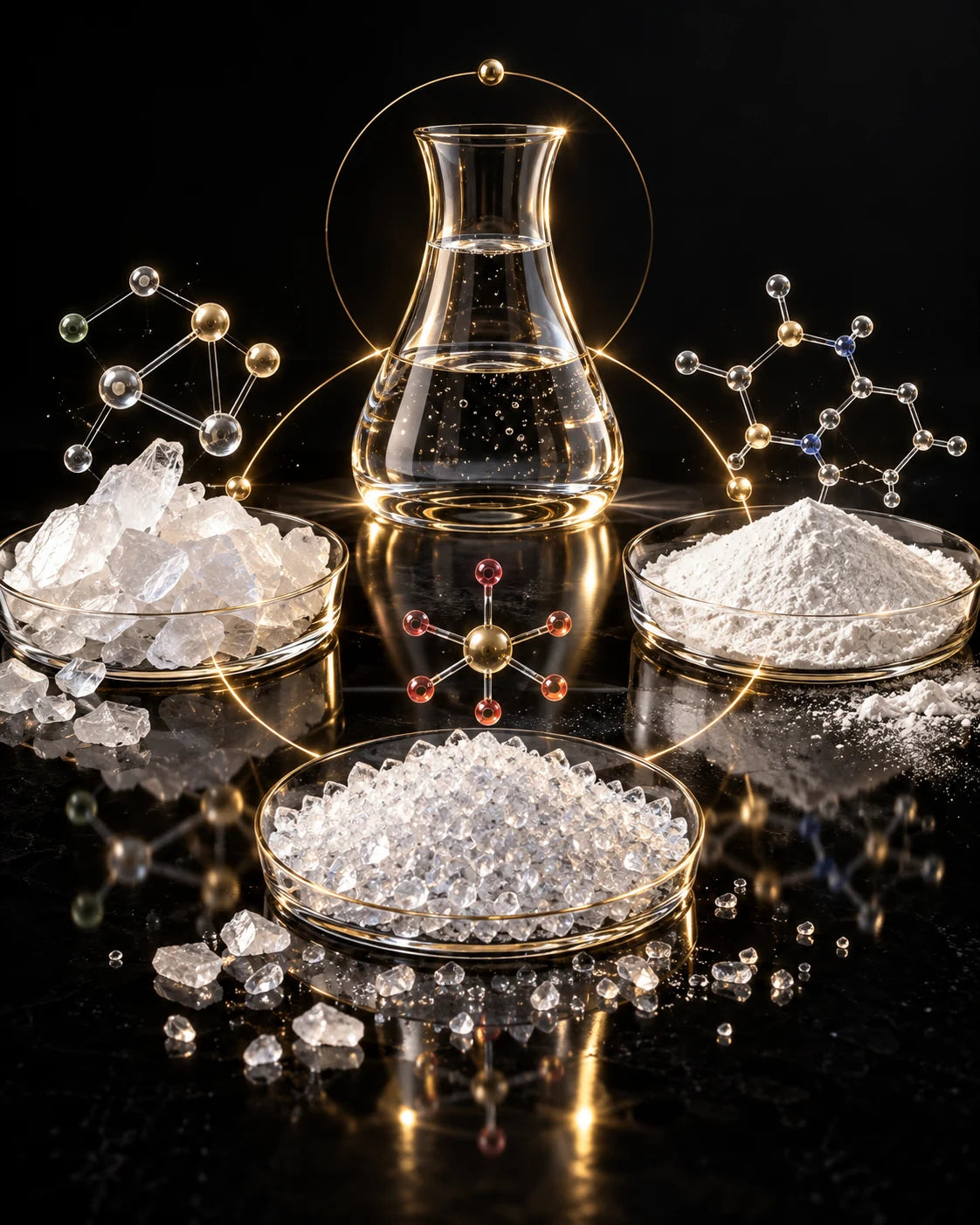
Chloride, sulphate and glycine coordination give the balms three different magnesium environments. MUSCLE-AID carries extra magnesium chloride for hard-working muscles.
Magnesium chloride · magnesium sulphate · magnesium diglycinate
In the balm: All three forms in ULTIMATE and MUSCLE-AID, with more magnesium chloride in MUSCLE-AID.
On this page
At a glance
Magnesium forms — magnesium chloride · magnesium sulphate · magnesium diglycinate
Products — ULTIMATE · MUSCLE-AID (more magnesium chloride)
Chemistry — chloride environment · sulphate environment · glycine coordination
Muscle research — muscle soreness · recovery · contraction · ATP-dependent energy metabolism
Pain biology — NMDA receptor signalling
Joint biology — magnesium sulphate in experimental osteoarthritis
Vehicle — oleic-acid-rich extra virgin olive oil · terpene-rich essential oils · beeswax
Magnesium sits at the heart of working muscle
Magnesium is involved in hundreds of enzyme reactions, including the ATP-dependent energy metabolism that powers every muscle contraction. It helps muscles contract and relax, supports normal nerve function and plays a central role in recovery after physical effort.
Magnesium already has a credible place in sport and muscle recovery. A systematic review examined magnesium supplementation specifically in physically active people experiencing exercise-related muscle soreness. Across the studies meeting its inclusion criteria, magnesium was associated with reduced muscle soreness and improvements across recovery-related outcomes.
Read the magnesium muscle-soreness systematic review →
That establishes the muscle relevance. Then the chemistry gets interesting.
Why magnesium matters to pain
Magnesium has legitimate pain biology. One of its most important roles is at the N-methyl-D-aspartate (NMDA) receptor. NMDA signalling is heavily involved in neuronal excitation and central sensitisation — the process through which the nervous system can amplify pain.
Magnesium acts as a natural gatekeeper at that receptor, which is one reason it has been studied across acute pain, neuropathic pain and chronic pain.
Read the magnesium pain-management review →
Three forms. Three environments.
Magnesium chloride
Magnesium chloride is highly water-soluble, creating a highly hydrated magnesium environment in which chloride interacts relatively weakly with magnesium compared with sulphate. MUSCLE-AID carries more of it than ULTIMATE.
Read the chloride/sulphate ion-pair research →
Magnesium sulphate
Replace chloride with sulphate and the chemistry changes substantially. Magnesium sulphate — the famous Epsom salt — shows much richer ion-pairing behaviour, including solvent-separated, solvent-shared and contact magnesium–sulphate pairs.
Read the MgSO₄ ion-pairing research →
Magnesium sulphate also has a striking joint story. In an experimental osteoarthritis model, magnesium sulphate delivered directly into affected knee joints reduced:
cartilage degeneration · synovitis · mechanical allodynia · thermal hyperalgesia
alongside reduced NMDA-receptor NR1 phosphorylation and reduced apoptosis in articular chondrocytes.
Read the magnesium sulphate osteoarthritis research →
Magnesium diglycinate
Magnesium diglycinate changes the environment again. Here glycine coordinates directly with magnesium, forming a chelate rather than a simple salt — a genuinely different coordination environment.
Read the magnesium coordination-chemistry review →
One mineral. Three chemical neighbourhoods.
Built into a rich, oil-and-wax balm
ULTIMATE and MUSCLE-AID disperse all three magnesium forms through a rich base of extra virgin olive oil, virgin coconut oil and beeswax, alongside a substantial essential-oil phase.
Extra virgin olive oil is rich in oleic acid — one of the best-studied fatty acids in skin-barrier research — while the balms’ essential oils bring terpenes such as menthol, eugenol, limonene and linalool, a family of compounds widely studied for the way they interact with the skin’s lipid structure.
Read the oleic-acid skin-barrier research →
Read the essential-oil terpene review →
Three magnesium forms. A terpene-rich essential-oil phase. An oleic-acid-rich lipid base.
How magnesium fits both balms
Magnesium is one of the ingredients whose role extends beyond its own biology. Its exercise and recovery research makes it relevant to hard-working, sore muscles. Its pain biology at the NMDA receptor makes it relevant to the signalling that keeps discomfort switched on. And its chloride, sulphate and glycine-associated forms give each balm three different chemical environments rather than one generic mineral.
The magnesium story is about more than containing magnesium — it’s how CannonBalm formulates it.
Magnesium inside a complete balm
Magnesium is one part of a carefully built whole. Around it sits an unusually substantial essential-oil phase rich in compounds studied for their effects on skin permeability. Peppermint contributes menthol-rich chemistry, clove contributes eugenol-rich chemistry, and bergamot and bergamot mint contribute terpene chemistry including limonene, linalyl acetate and linalool.
These molecules interact with the highly ordered lipid structure of the stratum corneum, influencing how the balms’ botanical actives partition into the skin. The surrounding extra virgin olive oil adds another layer: its oleic-acid-rich lipid environment is itself well established in skin-permeation research.
So both balms bring together three distinct environments:
Three chemically distinct forms of magnesium.
A high-load, multi-terpene essential-oil phase.
An oleic-acid-rich lipid vehicle.
That is how CannonBalm thinks about topical formulation: an entire balm designed around the skin — rich, slow-spreading and built to stay where it is applied — rather than a single ingredient added to a base.
Read the essential-oil penetration review →
Magnesium for working muscles
MUSCLE-AID is built for people whose muscles work hard — training, physical jobs, long days on their feet. It carries the extra magnesium chloride, alongside the most peppermint- and bergamot-mint-forward essential-oil blend of the two balms. ULTIMATE pairs the same three magnesium forms with its broader joint-focused botanicals: mangosteen, pomegranate, green tea, grape and liposomal ginger and turmeric.
Same mineral. Different chemistry. Built into a balm made to stay.
Technical evidence map
CannonBalm materials — magnesium chloride · magnesium sulphate · magnesium diglycinate in ULTIMATE and MUSCLE-AID; more magnesium chloride in MUSCLE-AID.
Muscle relevance — systematic review in physically active people: magnesium associated with reduced exercise-related muscle soreness and better recovery outcomes.
Pain biology — magnesium regulates NMDA-receptor signalling involved in neuronal excitation and central sensitisation.
Joint biology — intra-articular magnesium sulphate reduced cartilage degeneration, synovitis and pain behaviour in experimental osteoarthritis.
Chemistry — chloride (weak ion pairing) · sulphate (rich ion pairing) · diglycinate (glycine chelate).
Selected authoritative research
Magnesium and exercise-related muscle soreness
Systematic review. Journal of Translational Medicine. 2024. PMID 38970118. PMCID PMC11227245.
Magnesium and pain
Soleimanpour H et al. Postgraduate Medicine. 2022. PMID 35086408.
Magnesium sulphate in experimental osteoarthritis
Lee CH et al. Osteoarthritis and Cartilage. 2009. PMID 19490963.
Magnesium chloride and sulphate ion pairs
Götte L et al. Journal of Physical Chemistry A. 2017. PMID 28758749.
Ion pairing in MgSO₄(aq)
Buchner R, Chen T, Hefter G. Journal of Physical Chemistry B. 2004. DOI 10.1021/jp034870p.
Magnesium coordination chemistry
Case DR, Zubieta J, Doyle RP. Molecules. 2020. PMID 32664540. PMCID PMC7397051.
Oleic acid and the human skin barrier
Kováčik A et al. Molecular Pharmaceutics. 2023. PMID 37950377. PMCID PMC10698716.
Essential oils and skin penetration
Herman A, Herman AP. Journal of Pharmacy and Pharmacology. 2015. PMID 25557808.
Where Science Meets Nature.
Same mineral. Different chemistry.
Three forms of magnesium, built into a balm made for hard-working muscles and joints.