
POMEGRANATE EXTRACT
The power’s in the rind.
Painful, inflamed joints involve more than one biological system. Inflammatory signalling, prostaglandin biology and the enzymes involved in cartilage breakdown all play a part — and pomegranate’s punicalagins have been studied across every one of them.
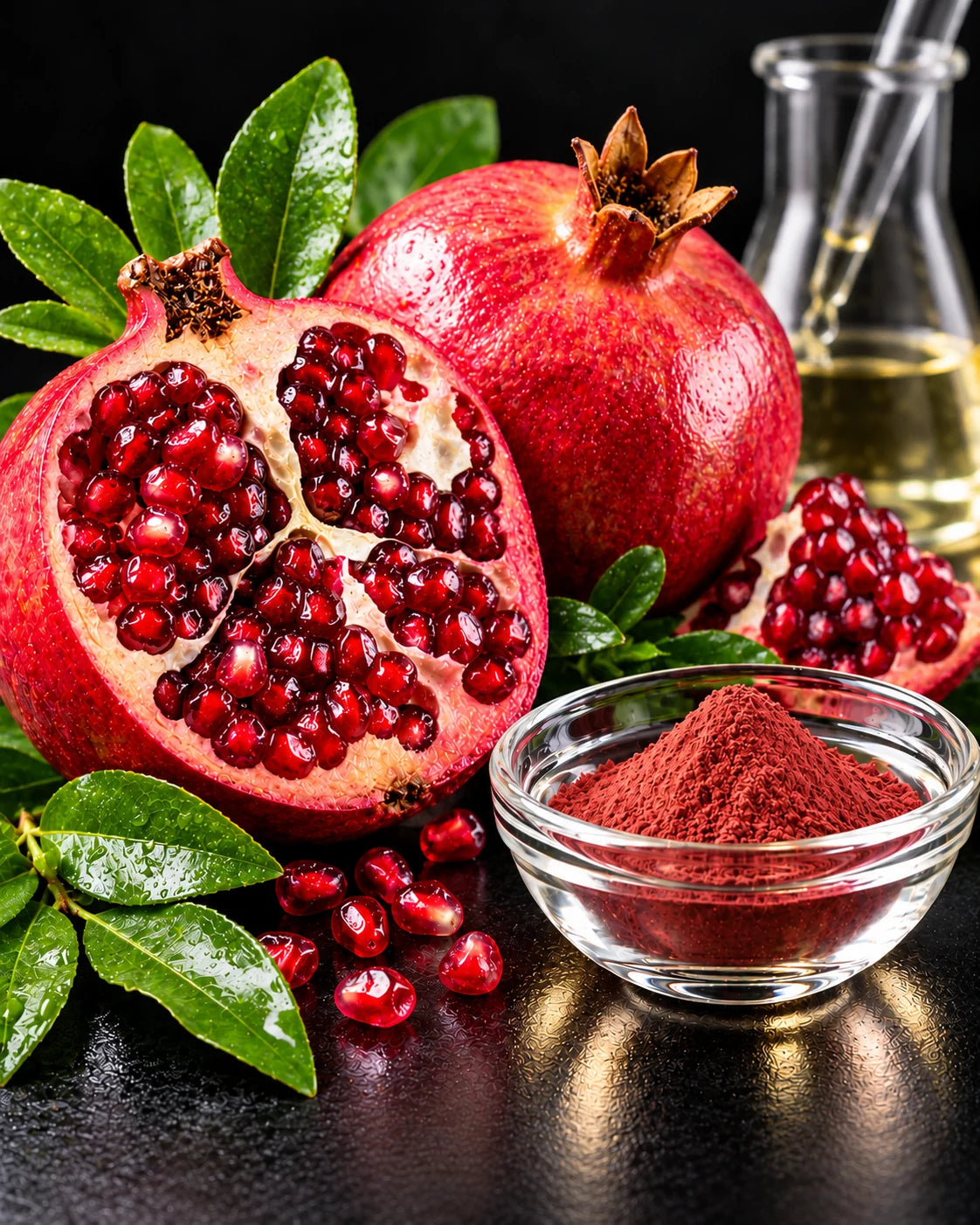
ULTIMATE and MUSCLE-AID both use pomegranate extract, rich in the ellagitannins that make pomegranate rind one of the most chemically remarkable parts of any fruit — with research reaching from human knees to intact skin.
Pomegranate extract · punicalagins · ellagic acid
In the balm: Pomegranate extract in ULTIMATE and MUSCLE-AID.
On this page
At a glance
Botanical — Punica granatum L.
Products — ULTIMATE · MUSCLE-AID
Principal chemical family — Hydrolysable ellagitannins
Major compounds — Punicalagin A/B · punicalin · ellagic acid · corilagin · granatins and related polyphenols
Peel chemical diversity — 64 phenolic compounds identified or annotated in one modern nine-cultivar analysis
Major research areas — COX-2 · NF-κB · MAPK signalling · cytokines · NLRP3 inflammasome · MMPs · type-II collagen · proteoglycan · chondrocyte autophagy
Route-relevant evidence — Direct ex-vivo skin penetration and COX-2 research · topical inflammatory and pain models
Human joint evidence — Human osteoarthritis chondrocyte studies plus randomised human knee-osteoarthritis research using pomegranate peel extract
Pomegranate peel has been tested in people with knee osteoarthritis
The story reaches human clinical research too. A randomised, double-blind, placebo-controlled clinical trial enrolled 60 women aged 38–60 with knee osteoarthritis.
Participants received either placebo or:
500 mg pomegranate peel hydroalcoholic extract twice daily
for an eight-week intervention alongside standard drug therapy. Knee Injury and Osteoarthritis Outcome Score — KOOS — and visual-analogue pain scores improved, with adjusted changes significantly greater in the pomegranate-peel group than the placebo group.
Read the randomised knee-OA trial through Monash University →
This is especially valuable because it is specifically pomegranate peel research — the ellagitannin-rich part of the fruit.
It is specifically:
Pomegranate peel. Human knees. Randomised. Double-blind. Placebo-controlled.
The human inflammatory markers moved too
A later randomised, double-blind, placebo-controlled study again enrolled 60 women with knee osteoarthritis, with 30 receiving 500 mg pomegranate peel extract twice daily for eight weeks and 30 receiving placebo alongside standard therapy.
Within the pomegranate-peel group, researchers recorded reductions of:
hs-CRP — 38.19% · NF-κB — 10.69% · MMP-1 — 28.57% · MCP-1 — 2.60%
The between-group analyses also showed significant differences favouring pomegranate peel extract for all four markers after adjustment.
Read the human knee-OA biomarker study on PubMed →
This connects the human clinical work directly back to mechanisms appearing throughout the laboratory literature:
inflammation · NF-κB · matrix metalloproteinases · joint-tissue biology
Now look at the cartilage science
Pomegranate research goes well beyond superficial inflammation. One of the most important studies used human osteoarthritis chondrocytes and human cartilage explants. Researchers stimulated the cells with IL-1β — a powerful inflammatory cytokine involved in cartilage catabolism.
A polyphenol-rich pomegranate extract inhibited IL-1β-induced expression of:
MMP-1 · MMP-3 · MMP-13
It also inhibited proteoglycan breakdown in human cartilage explants.
The same research found inhibition of:
p38 MAPK · IκBα phosphorylation · NF-κB DNA-binding activity
Read the human OA chondrocyte study on PubMed →
Open the Journal of Nutrition paper →
This matters because MMPs are enzymes directly involved in extracellular-matrix breakdown — and MMP-13 is especially important in cartilage because of its ability to degrade type-II collagen.
Punicalagin and type-II collagen
Now to pomegranate’s signature compound. Researchers studied punicalagin itself against type-II collagen degradation. Punicalagin inhibited MMP-13-mediated degradation of type-II collagen in vitro.
In IL-1β-stimulated bovine cartilage, punicalagin also inhibited loss of:
proteoglycan · type-II collagen
in a concentration-dependent manner. The research then moved into an inflammatory arthritis model, where the higher tested punicalagin dose significantly reduced paw swelling.
Read the punicalagin MMP-13/type-II collagen study on PubMed →
That creates a direct chemical connection:
Punicalagin → MMP-13 → type-II collagen
That direct line from a pomegranate compound to the collagen that keeps cartilage strong is why punicalagin-rich pomegranate earns its place in both balms.
Punicalagin can physically interact with cartilage
Another study asked a fascinating question:
What happens when punicalagin comes directly into contact with cartilage? Researchers investigated punicalagin interaction and diffusion in articular cartilage and found that it increased cartilage resistance to degradation by collagenase and hyaluronidase. Punicalagin also reacted directly with collagenase and reduced subsequent enzyme activity. Experimental osteoarthritis work in the same research programme found reduced cartilage loss with punicalagin treatment.
Explore the punicalagin/cartilage research on PubMed →
This is research involving:
cartilage · collagen · collagenase · MMP-13 · extracellular-matrix degradation
Punicalagin and osteoarthritis progression
More recent studies have taken the cartilage story deeper.
In chondrocytes and an experimental osteoarthritis model, punicalagin promoted autophagy, reduced inflammatory injury and inhibited extracellular-matrix degradation through a signalling axis involving:
FoxO1 → PRG4 → HIF-3α
The researchers reported attenuation of osteoarthritis progression alongside these changes.
Read the FoxO1–PRG4–HIF-3α osteoarthritis study on PubMed →
Another study found punicalagin increased:
HO-1 · SOD1
while reducing oxidative stress, apoptosis and extracellular-matrix degradation. It also restored autophagic activity in stressed chondrocytes and reduced articular-cartilage degeneration in a DMM osteoarthritis model.
Read the punicalagin autophagy/OA study on PubMed →
The punicalagin story therefore reaches across several layers of joint biology:
inflammation → oxidative stress → autophagy → matrix degradation → cartilage integrity
Human osteoarthritis chondrocytes
The human-cell research is equally interesting.
A later study using primary human osteoarthritis chondrocytes found that a polyphenol-rich pomegranate extract reduced:
IL-6 · reactive oxygen species
and interfered with several steps in the NF-κB signalling cascade.
Researchers observed inhibition of:
IKKβ phosphorylation · IκBα degradation · NF-κB/p65 activation and nuclear translocation · NF-κB-inducing kinase — NIK
Read the primary human OA chondrocyte study on PubMed →
Put alongside the earlier human chondrocyte work on MMP-1, MMP-3 and MMP-13, it gives pomegranate unusually detailed experimental evidence inside cells taken from human osteoarthritic joints.
PGE₂, MMP-13, collagen II and aggrecan
Pomegranate joint research has also examined the broader network surrounding cartilage degradation.
In experimental post-traumatic osteoarthritis, pomegranate polyphenol extract was associated with lower:
PGE₂ · IL-6 · MMP-3 · MMP-9 · MMP-13
and greater expression of:
aggrecan · COL2A1 — type-II collagen
The researchers also recorded less cartilage degeneration and fewer apoptotic chondrocytes.
Read the post-traumatic OA study on PubMed →
Read the complete paper on PMC →
This is why pomegranate earns a place in both balms’ pathway-convergence story.
It touches both sides of the problem:
inflammatory signalling and the tissue-degradation machinery activated downstream.
Why pomegranate belongs beside mangosteen
The ingredients in ULTIMATE and MUSCLE-AID are chosen to work together. The interesting part is where their biology begins to converge — and pomegranate reaches more of those points than almost any other botanical.
COX / prostaglandin biology — Direct topical COX-2 reduction in intact ex-vivo skin · PGE₂ findings in joint research
NF-κB — Human OA chondrocytes · human knee-OA biomarker data · punicalagin studies
MAPK — p38 · JNK · ERK signalling research
Inflammatory cytokines — IL-1β · TNF-α · IL-6 · IL-18
Inflammasome biology — NLRP3 · caspase-1 · pyroptosis
Cartilage matrix — MMP-1 · MMP-3 · MMP-13 · proteoglycan · type-II collagen
Oxidative stress — ROS · mitochondrial ROS · HO-1 · SOD1
Autophagy / chondrocyte biology — FoxO1 · PRG4 · HIF-3α
Human skin matrix — Type-I procollagen · MMP-1
Topical delivery — Punicalagin penetration through intact ex-vivo skin
Pomegranate earned its place.
Punicalagin penetrated intact skin
Researchers applied pomegranate rind extract to freshly excised porcine skin mounted in Franz diffusion cells. The stratum corneum — the skin’s principal external barrier — remained intact. They measured both inflammatory biology and where the pomegranate compounds travelled. The result was striking.
Punicalagin penetrated the intact skin. It was detected throughout the skin profile and particularly in the lower regions. The distribution indicated that appendageal structures such as hair follicles provided an important route into the viable epidermis.
Read the ex-vivo skin study on PubMed →
That alone makes this unusually relevant topical research. But the researchers also measured what happened to COX-2.
COX-2 fell — and stayed down
COX-2 sits within the arachidonic-acid pathway that generates inflammatory prostaglandins.
After topical pomegranate rind extract was applied to intact ex-vivo skin:
COX-2 expression was significantly downregulated after just 6 hours.
And the reduction was maintained for:
up to 24 hours
A detailed report of the model found that 1 mg/mL pomegranate rind extract reduced COX-2 expression by 66.5 ± 3.6% after six hours.
Read the primary ex-vivo skin study on PubMed →
Open the detailed ex-vivo COX-2 analysis →
That brings three unusually valuable observations together in one experiment:
topical application → skin penetration of punicalagin → modulation of COX-2 in viable skin. This is exactly the kind of route-specific science CannonBalm looks for.
The whole rind extract reduced COX-2 more strongly than the tannins alone
The same research compared the complete pomegranate rind extract with an isolated total-pomegranate-tannin fraction. Both affected COX-2. But the complete rind extract downregulated COX-2 more strongly than the isolated tannin fraction.
Read the whole-extract versus tannin comparison →
That suggests an important principle:
Punicalagins are a major reason to choose a punicalagin-rich extract. The complete rind chemistry brings even more.
That mirrors the same formulation philosophy behind CannonBalm’s three forms of mangosteen:
Standardise the star compounds. Preserve the broader botanical chemistry.
COX-2 — from the laboratory directly into skin
One reason the COX-2 evidence deserves special emphasis is route. The Cardiff pomegranate work placed rind extract directly onto intact skin. Punicalagin moved through the skin. And COX-2 expression fell in the viable epidermis.
Read the ex-vivo topical COX-2 study →
That makes this one of the most valuable pieces of formulation-relevant botanical evidence behind both balms.
Topical inflammation and pain research
Another landmark study examined a standardised pomegranate rind extract — SPRE — applied topically at 1%, 2.5% and 5% w/w in a series of inflammatory and pain models.
The study investigated acute inflammation, chronic polyarthritis and pain-related responses using croton-oil ear inflammation, carrageenan paw inflammation, complete-Freund’s-adjuvant polyarthritis, mechanical hyperalgesia and formalin testing.
Read the standardised topical rind-extract study on PubMed →
The extract produced dose-dependent anti-inflammatory effects.
At the highest concentration, inhibition of croton-oil-induced ear oedema reached:
86.30%
It also attenuated carrageenan inflammation and CFA-induced polyarthritis. At 5%, the extract demonstrated significant topical analgesic activity in both mechanical hyperalgesia and formalin pain testing.
The researchers linked the anti-inflammatory and analgesic effects with reduced leukocyte infiltration and modulation of inflammatory cytokines including:
IL-1β · TNF-α
Whole rind extract versus isolated ellagic acid
That study becomes even more interesting because researchers ran the standardised rind extract alongside equivalent amounts of ellagic acid, one of pomegranate’s best-known individual polyphenols.
The complete rind extract was:
more active as an anti-inflammatory agent than the equivalent isolated ellagic acid
This is central to CannonBalm’s raw-material philosophy. Ellagic acid matters. Punicalagins matter enormously. And the complete extract brings the broader chemistry that makes the botanical so effective in this research.
NF-κB — one of the strongest recurring themes
One pathway keeps appearing throughout the pomegranate literature:
NF-κB
NF-κB is a major transcriptional regulator of inflammatory gene expression. In primary human OA chondrocytes, pomegranate extract inhibited NF-κB activation and nuclear translocation.
In randomised human knee-OA peel-extract research, serum NF-κB was also significantly reduced relative to placebo after adjustment.
And punicalagin itself has influenced NF-κB-associated inflammatory biology in experimental joint and immune models.
Read the punicalagin arthritis/NF-κB paper →
That creates a remarkable line running from:
pomegranate extracts → human cartilage cells → punicalagin → randomised human knee-OA biomarker research
NLRP3, pyroptosis and inflammatory cytokines
Punicalagin research also reaches the NLRP3 inflammasome. In collagen-induced arthritis, punicalagin reduced joint inflammation, cartilage damage and bone destruction.
It shifted macrophage biology away from the inflammatory M1 phenotype and reduced expression of:
NLRP3 · caspase-1 · IL-1β · IL-18
The same study connected these changes with reduced NF-κB signalling and reduced inflammatory cell death through pyroptosis.
Read the punicalagin NLRP3/arthritis study on PubMed →
Separate experimental work reported punicalagin suppression of:
ERK · JNK · p38 MAPK · NF-κB · NLRP3 · intracellular ROS · mitochondrial ROS
along with reductions in iNOS, COX-2, IL-1β and IL-6.
Read the MAPK/NF-κB/NLRP3 punicalagin study →
This gives punicalagin another important point of convergence with the balms’ broader inflammatory architecture.
Why delivery matters with punicalagin
Punicalagin is a very large polyphenolic molecule. Its molecular mass is approximately 1084.7 Da.
That makes the Franz-cell findings particularly interesting. Rather than relying on assumptions about what such a large molecule might do, the researchers measured it. They detected punicalagin throughout intact skin, particularly in lower regions, and implicated appendageal structures as an important route to the viable epidermis.
This is a principle that runs throughout CannonBalm:
Ingredient chemistry tells us what might be possible.
Delivery research shows us what the material can actually do at the skin interface.
ULTIMATE and MUSCLE-AID combine pomegranate extract with a lipid-rich botanical balm designed for prolonged contact with the skin. The extract gives us the starting chemistry. The formulation determines how that chemistry is presented to the skin.
Human skin and collagen biology
Pomegranate peel also has a substantial skin-matrix story. Researchers compared extracts from peel, fermented juice, seed cake and seed oil in human skin cells.
Pomegranate peel extract:
increased type-I procollagen synthesis
and:
reduced MMP-1 production
in human dermal fibroblasts. The peel extract produced stronger dermal-fibroblast effects than the fermented juice or seed-cake fractions in that research.
Read the human dermal-fibroblast study on PubMed →
The fraction matters · the plant part matters · the chemistry matters.
Pomegranate peel has also been used topically in humans
There is human topical peel-extract research outside the pain field as well. A phenolic-rich pomegranate peel extract was formulated into topical serum and mask products and evaluated in 30 human volunteers.
The researchers reported no irritation in a single-application closed patch test and then conducted a:
randomised · double-blind · placebo-controlled · split-face trial
over 28 consecutive daily treatments. The pomegranate-peel formulations produced greater improvement in the measured pigmentation endpoint than placebo.
Read the human topical pomegranate-peel study on PubMed →
Different objective. Same important formulation fact:
Pomegranate peel extracts have been formulated and studied directly on human skin.
Topical tissue-repair research
Pomegranate peel has also been studied topically in a large-animal tissue-injury model.
In a minipig second-degree burn model, topical pomegranate peel extract accelerated wound-healing measures and was associated with earlier regulation of:
VEGF-A · TGF-β1
Researchers followed the tissue over 28 days and observed improvements in healing, decrustation and tissue morphology.
Read the pomegranate-peel burn study on PubMed →
This adds another layer to the tissue biology surrounding pomegranate rind.
Why the rind matters
The ruby-red arils get all the attention. But some of the most remarkable chemistry in a pomegranate sits in the part most people throw away. The rind — or pericarp — is extraordinarily rich in ellagitannins, a family of large polyphenolic compounds dominated by punicalagins and accompanied by punicalin, ellagic acid, corilagin, granatins and dozens of other phenolics.
Modern analytical research has identified or annotated 64 phenolic compounds in pomegranate peel, with punicalagin among the dominant compounds.
Read the 64-compound pomegranate-peel analysis on PubMed →
Pomegranate is a perfect example of why CannonBalm cares about plant part as well as ingredient name. The red arils, juice, seeds and rind are chemically different materials. A detailed Food Chemistry analysis identified 48 phenolic compounds across pomegranate peel, mesocarp, arils and juices, including 22 ellagitannins.
Punicalagin was particularly concentrated in the peel and mesocarp, at approximately 11–20 g/kg dry matter. Juice concentrations varied enormously — approximately 4–565 mg/L — depending partly on how the fruit was processed and how much peel chemistry entered the juice.
Read the Food Chemistry analysis on PubMed →
A more recent investigation of nine different pomegranate cultivars went considerably deeper.
Researchers identified or annotated:
64 phenolic compounds in pomegranate peel
Twenty-three were reported in pomegranate peel for the first time.
Among the dominant compounds were:
punicalagin · ellagic acid · gallocatechin · punicalin · catechin · corilagin Punicalagin alone ranged from approximately 28.03 to 104.14 mg per gram of peel across the cultivars studied.
Read the nine-cultivar peel study on PubMed →
So the CannonBalm choice is very deliberate.
The power’s in the rind.
Punicalagins and the whole pomegranate
Just as mangosteen is more than α-mangostin, pomegranate rind is more than punicalagin. Punicalagins give CannonBalm a powerful marker and a substantial body of research — and modern chemical profiling shows an elaborate ellagitannin and polyphenol system around them.
Pomegranate peel contains compounds including:
punicalagin A and B · punicalin · ellagic acid · corilagin · granatins · pedunculagin-related tannins · gallic-acid derivatives · catechin · gallocatechin · numerous ellagic-acid derivatives Across one nine-cultivar investigation, researchers identified or annotated 64 phenolic compounds.
That broader chemistry helps explain why whole-rind extracts can behave differently from single isolated compounds.
From bright red fruit to serious joint science
The visual image of pomegranate is beautiful. Bright ruby arils. Deep red juice. A fruit used for thousands of years. But for ULTIMATE and MUSCLE-AID, the interesting part is the chemistry of the rind.
The rind brings:
one of the fruit’s richest ellagitannin fractions · punicalagins as major marker compounds · direct topical skin-penetration research · COX-2 modulation in viable skin · topical inflammation and pain research
human OA chondrocyte research · MMP and cartilage biology · punicalagin-specific type-II collagen research · NLRP3 and NF-κB research · randomised human knee-osteoarthritis peel-extract data
That is what “contains pomegranate” means in a CannonBalm balm.
Technical summary
Ingredient — Punica granatum L. extract · Products — ULTIMATE · MUSCLE-AID
Principal chemical family — Hydrolysable ellagitannins
Other important chemistry — Punicalin · ellagic acid · corilagin · granatins · gallagic/ellagic-acid derivatives and other polyphenols
Peel diversity — 64 phenolics identified/annotated in a nine-cultivar UHPLC/UPLC study
Natural peel concentration context — Punicalagin approximately 28.03–104.14 mg/g across nine cultivars in one modern study
Direct topical skin evidence — Punicalagin detected through intact ex-vivo skin; rind extract reduced epidermal COX-2
COX-2 result — Significant reduction after 6 h, maintained up to 24 h; detailed model report 66.5 ± 3.6% reduction after 6 h
Inflammation/pain models — Ear oedema · carrageenan inflammation · CFA polyarthritis · mechanical hyperalgesia · formalin pain
Human OA cellular research — MMP-1/-3/-13 · proteoglycan degradation · p38 MAPK · NF-κB · IL-6 · ROS
Punicalagin cartilage research — MMP-13 · type-II collagen · proteoglycan · collagenase · autophagy · ECM degradation
Punicalagin OA signalling — FoxO1 · PRG4 · HIF-3α · HO-1 · SOD1
Inflammasome research — NLRP3 · caspase-1 · IL-1β · IL-18 · pyroptosis
Human knee-OA research — Randomised double-blind placebo-controlled pomegranate-peel clinical research
Human knee biomarkers — hs-CRP · NF-κB · MMP-1 · MCP-1
Human topical skin evidence — Randomised double-blind split-face peel-extract study plus human patch-tolerance assessment
Selected authoritative research
Direct topical pomegranate rind extract — skin penetration and COX-2
Standardized rind extract — topical inflammation, polyarthritis and analgesia
Mo J et al. Journal of Ethnopharmacology. 2013. PMID 23743057 · DOI 10.1016/j.jep.2013.05.040.
Pomegranate peel chemistry — 48 phenolics / 22 ellagitannins
Pomegranate peel chemistry — 64 identified or annotated phenolics
Cardiff rind extract — approximately 20% punicalagin by HPLC
Houston DMJ et al. PLOS ONE. 2017. PMID 28665969 · DOI 10.1371/journal.pone.0179291.
Human osteoarthritis chondrocytes — MMPs, p38 MAPK and NF-κB
Primary human OA chondrocytes — IL-6, ROS, IKKβ, NIK and NF-κB
Punicalagin — MMP-13 and type-II collagen
Punicalagin — autophagy and experimental osteoarthritis
Punicalagin — FoxO1 / PRG4 / HIF-3α
Punicalagin — arthritis, NLRP3 and pyroptosis
PMID 34125371 · DOI 10.1007/s11427-020-1939-1.
Punicalagin — MAPK / NF-κB / NLRP3 / ROS
Post-traumatic OA — PGE₂, MMPs, aggrecan and type-II collagen
Akhtar N et al. Nutrition. 2017. PMID 27908544 · PMCID PMC5137805 · DOI 10.1016/j.nut.2016.08.004.
Randomised human knee-OA pomegranate-peel trial
Randomised human knee-OA inflammatory-marker study
Human dermal fibroblasts — procollagen and MMP-1
Aslam MN et al. Journal of Ethnopharmacology. 2006. PMID 16221534 · DOI 10.1016/j.jep.2005.07.027.
Human topical pomegranate-peel study
Pomegranate peel — topical tissue-healing research
Burns. PMID 34716043 · DOI 10.1016/j.burns.2021.06.004.
One fruit. A remarkable rind.
Pomegranate has been celebrated for centuries.
Modern analytical chemistry tells us something much more specific. Much of the really interesting chemistry sits in the rind.
That is where punicalagins and a remarkable spectrum of ellagitannins are concentrated. That is where researchers found a botanical extract capable of moving through intact skin and reducing COX-2. That is the material studied topically in inflammation, polyarthritis, hyperalgesia and pain models.
That is the chemistry connected with MMP-13, type-II collagen, proteoglycan, NF-κB, NLRP3 and cartilage biology. And pomegranate peel itself has made it all the way into randomised, double-blind, placebo-controlled human knee-osteoarthritis research.
The power’s in the rind.
Where Science Meets Nature.
The power’s in the rind.
One fruit. A remarkable rind. Research reaching from human knees to intact skin.