
PEPPERMINT ESSENTIAL OIL
Target muscle pain through the sensory system.
Peppermint is easy to think of as a cooling ingredient. In ULTIMATE and MUSCLE-AID its role is far more specific.
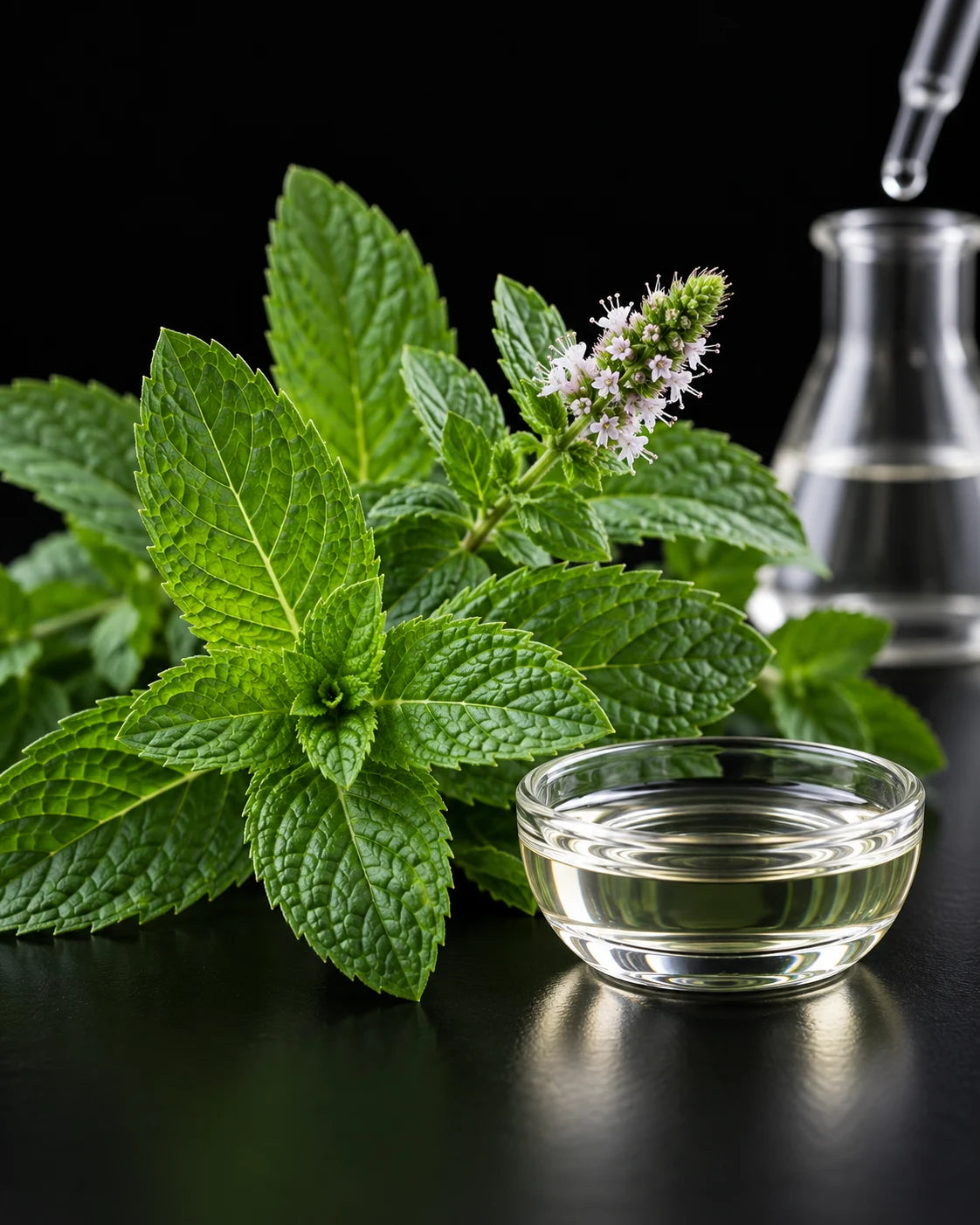
Menthol — peppermint oil’s dominant natural constituent — acts directly within peripheral sensory biology. Human topical studies have shown reduced pain sensitivity across muscles and tendons, while research in exercise-induced muscle soreness found less pain and greater muscle force after topical menthol. MUSCLE-AID is the more peppermint-forward of the two balms.
Whole peppermint essential oil · certified organic
In the balm: Peppermint essential oil in ULTIMATE and, in larger amount, MUSCLE-AID.
On this page
At a glance
Material — whole Mentha × piperita essential oil · certified organic
Products — MUSCLE-AID (peppermint-forward) · ULTIMATE
Primary natural constituent — (−)-menthol. Other characteristic volatiles include menthone, menthyl acetate and 1,8-cineole.
Primary sensory pathway — TRPM8
Human topical evidence — muscle and tendon pain sensitivity · exercise-induced muscle soreness · topical exercise research · carpal tunnel · tension-type headache
Human DOMS research — menthol vs ice
One of the most directly relevant studies for sore muscles deliberately induced delayed-onset muscle soreness in physically active adults. Participants performed 100 eccentric contractions of the elbow flexors. Two days later, once soreness had developed, researchers compared a topical gel containing 3.5% menthol with ice. The menthol treatment produced significantly lower pain than ice and permitted 116.9% greater electrically evoked tetanic force.
Pain isn’t just an unpleasant sensation; it can also hold back how much force a sore muscle is willing or able to produce. In this study, topical menthol improved both the pain experience and the force that could be evoked from the sore muscle.
LESS PAIN THAN ICE · 116.9% GREATER EVOKED FORCE
Read the menthol-versus-ice DOMS study →
Less pain sensitivity across muscles and tendons
A randomised human study tested a menthol-based topical analgesic across a broad set of upper- and lower-body muscles and tendons — the deltoid, biceps, quadriceps, hamstrings, gastrocnemius and lumbosacral erector spinae, together with the lateral elbow, patellar and Achilles tendons. Fifteen minutes after application, overall pain-pressure threshold increased by approximately 11.6%, with a large effect size of d = 1.05.
In practical terms, more pressure was required before the stimulus became painful. That gives menthol a direct human connection to musculoskeletal pain sensitivity rather than reducing its role to a cooling sensation.
~11.6% HIGHER PAIN-PRESSURE THRESHOLD AT 15 MINUTES
The endpoint that matters: how much pressure could be tolerated before it became painful — and it went up.
Read the randomised human pain-pressure study →
Topical menthol during exercise
The exercise literature has moved beyond individual studies. A 2026 systematic review and meta-analysis examined acute topical menthol during exercise. Sixteen controlled studies involving 191 participants were included. Across the pooled evidence, topical menthol produced a statistically significant improvement in exercise performance and reduced perceived exertion and thermal sensation, with core body temperature unchanged.
That last point is particularly revealing: the sensory experience changed while core temperature held steady. Menthol was changing perception — how hard the work feels.
Read the 2026 menthol-and-exercise meta-analysis →
Human nerve-related pain: carpal tunnel syndrome
A triple-blind randomised placebo-controlled crossover study examined topical menthol in workers with carpal tunnel syndrome and chronic arm/hand pain. Compared with placebo, topical menthol reduced arm/hand pain by 1.2 points on a 0–10 scale, with a reported moderate effect size of 0.63. Pain and global-rating-of-change outcomes both favoured topical menthol.
Read the randomised carpal-tunnel trial →
Genuinely topical, genuinely human — and directly related to persistent nerve-associated pain.
What peppermint adds
Every ingredient in the balms earns its place by doing something the others don’t. Mangosteen and pomegranate lean heavily into inflammation, cartilage and tissue biology. Clove brings numbing, local-anaesthetic-style action on sodium and calcium channels, TRPA1, TRPV1 and P2X3. Bergamot and bergamot mint calm peripheral nerve excitability through linalool, linalyl acetate and limonene. Magnesium brings muscle and NMDA pain biology.
Peppermint brings a particularly clean sensory pathway: TRPM8 — a cold-sensitive ion channel expressed in peripheral sensory neurons.
Different chemistry, different biological entry points — exactly what a multi-pathway topical formula should deliver. And peppermint adds the fresh, cooling comfort you feel within minutes.
Different chemistry. Different receptor. Different route into pain perception.
TRPM8 — the signal changes before the temperature does
Menthol activates TRPM8 — transient receptor potential melastatin 8 — one of the peripheral nervous system’s major cold-sensitive sensory receptors. TRPM8 allows sensory neurons to detect cooling, and menthol activates that pathway chemically. That’s why menthol creates a powerful perception of coolness without the tissue chill of ice. For sore muscles and joints, this matters because pain and discomfort are ultimately experienced through sensory signalling.
The central pathway is straightforward:
Menthol → TRPM8 → altered peripheral sensory signalling.
A landmark study used both genetic and pharmacological approaches to test whether TRPM8 actually mediated menthol analgesia. L-menthol reduced pain behaviours produced by multiple acute and inflammatory stimuli, but when TRPM8 was genetically removed or pharmacologically blocked, menthol-induced analgesia disappeared.
The core pathway is simple: Menthol → TRPM8 → altered peripheral pain signalling.
Your body’s own pain control switches on too
The same TRPM8 study found that menthol-induced analgesia was blocked by naloxone, an opioid-receptor antagonist — showing that activating this cold-sensing sensory pathway recruits part of the body’s own opioid-dependent pain-control system.
That gives peppermint a distinct job in both balms: it enters the pain problem through sensory-neural biology, complementing the inflammatory pathways covered elsewhere in the formula.
Menthol does more than TRPM8
TRPM8 is the dominant menthol analgesic pathway, and the pharmacology reaches further. Research also connects menthol with TRPA1, voltage-gated sodium channels, calcium influx, metabotropic glutamate signalling and endogenous opioid signalling.
A modern review describes menthol analgesia as involving TRPM8 alongside modulation of neuronal sodium and calcium currents and downstream glutamatergic and opioid systems.
Read the modern menthol pain-mechanism review →
Whole peppermint oil has human topical pain evidence of its own
Whole peppermint oil has its own human topical pain evidence. A randomised double-blind placebo-controlled crossover trial tested 10% peppermint oil in ethanol in people with tension-type headache.
Across 164 headache attacks in 41 patients, topical peppermint oil significantly reduced headache intensity versus placebo within 15 minutes, and the reduction persisted through the one-hour observation period. In that trial, the peppermint-oil preparation performed on par with 1,000 mg paracetamol.
Read the randomised whole-peppermint-oil trial →
That demonstrates something important for both balms: whole peppermint essential oil itself has shown topical human analgesic activity. A later clinical review also described topical peppermint oil as an established treatment for acute tension-type headache in parts of Europe.
Read the clinical peppermint-oil review →
Topical menthol has also been tested in migraine
A separate randomised triple-blind placebo-controlled crossover study examined 10% topical menthol on the forehead and temporal area in 35 patients across 118 migraine attacks. The menthol preparation was statistically superior to placebo for 2-hour pain freedom, 2-hour pain relief, sustained pain freedom and sustained pain relief.
Read the randomised topical-menthol migraine trial →
Supporting topical pain evidence — and another human result for peppermint applied to the skin.
Menthol gets into human skin — and the formulation shapes it
In full human skin mounted in diffusion cells, menthol distribution varied substantially between commercial topical preparations. Vehicle, menthol concentration and the other ingredients present all affected where menthol accumulated and how deeply it penetrated.
Read the human-skin menthol disposition study →
Menthol is also used experimentally as a terpene penetration enhancer — peppermint’s dominant constituent interacts meaningfully with both sensory nerves and the skin barrier.
Menthol also changes cutaneous physiology
Human studies have shown topical menthol increases cutaneous blood flow. One study reported a significant increase after menthol application, while a later double-blind crossover experiment found TRPM8 activation increased blood flow at the treated site and across the same dermatome.
Read the human blood-flow study →
Menthol does far more than create a surface sensation.
Whole peppermint oil has inflammatory biology too
Peppermint’s headline role is sensory and neural, and the whole oil also has experimental inflammatory activity. In one GC-MS-characterised study, peppermint oil reduced experimental oedema and reduced nitric oxide and prostaglandin E₂ (PGE₂) production in activated macrophages.
Read the peppermint-oil inflammation study →
Supporting biology alongside the balms’ inflammation-focused botanicals.
Peppermint is also part of the delivery architecture
Peppermint’s job doesn’t end at sensory signalling. Menthol is also widely studied as a skin-permeation enhancer. Full human-skin diffusion research shows menthol entering the stratum corneum and deeper skin compartments, with its distribution shaped by the surrounding formulation. Both balms place peppermint inside a rich, terpene-rich essential-oil system.
Peppermint contributes menthol. Clove contributes eugenol. Bergamot and bergamot mint contribute limonene, linalool and linalyl acetate. Around them sits an oleic-acid-rich base of extra virgin olive oil, virgin coconut oil and beeswax. So peppermint contributes on two connected levels: sensory pharmacology and formulation architecture.
Read the essential-oil penetration review →
Why whole peppermint oil
Menthol is one molecule. Peppermint essential oil is a naturally assembled volatile mixture containing menthol plus menthone, menthyl acetate, 1,8-cineole, limonene and other terpenes. Published samples have reported menthol around 40–47% and menthone around 23–26%, alongside the broader volatile profile.
Read one peppermint chemistry study →
Both balms use the whole certified organic botanical oil — the complete natural volatile profile of the peppermint plant, built around its dominant menthol.
The peppermint we use
Botanical — Mentha × piperita L., an accepted hybrid of Mentha aquatica × Mentha spicata. Whole peppermint essential oil, certified organic.
The key natural constituent is (−)-menthol / L-menthol, and the ingredient is the whole oil — so the balms carry both the constituent studied in menthol research and the full botanical oil studied in whole-peppermint trials.
MUSCLE-AID carries the larger amount of peppermint — a cooler, fresher, more peppermint-forward balm for working muscles. ULTIMATE uses peppermint alongside its larger clove and bergamot blend.
Peppermint inside the balms’ pathway architecture
Human muscle soreness — topical menthol: less pain than ice and greater evoked force · Human pain sensitivity — pain-pressure threshold up ~11.6% · Human nerve-related pain — randomised carpal-tunnel crossover trial.
Primary sensory pathway — TRPM8 · Endogenous pain control — opioid-dependent signalling downstream of TRPM8 · Peripheral excitability — sodium/calcium-channel interactions · Additional sensory biology — TRPA1 and glutamatergic signalling.
Whole-oil human evidence — randomised topical tension-headache trial · Skin delivery — human-skin menthol deposition is vehicle dependent · Whole-oil inflammation — PGE₂ · nitric oxide · experimental oedema.
Target muscle pain through the sensory system.
Technical summary
Ingredient — Mentha × piperita essential oil · certified organic · accepted hybrid of M. aquatica × M. spicata · Products — MUSCLE-AID (peppermint-forward) · ULTIMATE
Primary natural active — (−)-menthol / L-menthol · Other characteristic volatiles — menthone · menthyl acetate · 1,8-cineole · isomenthone · menthofuran · limonene.
Primary sensory target — TRPM8 · Additional mechanisms — TRPA1 · sodium channels · calcium signalling · glutamatergic signalling · endogenous opioid pathways.
Human pressure-pain study — topical menthol increased pain-pressure threshold ~11.6% · Human carpal-tunnel trial — pain reduced 1.2 points vs placebo.
Whole peppermint-oil trial — 10% topical oil · 41 patients · 164 tension-headache attacks · significant pain reduction from 15 minutes. Human-skin diffusion research — menthol disposition strongly vehicle dependent.
Human DOMS — 3.5% menthol gel: lower pain than ice and 116.9% greater evoked tetanic force · Exercise meta-analysis — 16 studies, 191 participants.
Selected authoritative research
Topical menthol vs ice in DOMS
Topical menthol and exercise — meta-analysis
Journal of Thermal Biology. 2026. PMID 42385298.
Human pain sensitivity
Behm DG et al. Journal of Sport Rehabilitation. 2022. PMID 34552033 · DOI 10.1123/jsr.2021-0144.
Human carpal-tunnel pain
Whole peppermint essential oil — randomised topical pain trial
Göbel H et al. Der Nervenarzt. 1996. PMID 8805113 · DOI 10.1007/s001150050040.
Topical menthol migraine trial
TRPM8-mediated menthol analgesia
Liu B et al. Pain. 2013. PMID 23820004 · PMCID PMC3778045 · DOI 10.1016/j.pain.2013.06.043.
Modern menthol pain-mechanism review
Human-skin menthol disposition
Cal K. Biopharmaceutics & Drug Disposition. 2008. PMID 18985797 · DOI 10.1002/bdd.631.
Peppermint essential-oil inflammatory biology
Sun Z et al. PLOS ONE. 2014. PMID 25493616.
Peppermint essential-oil chemistry
Schmidt E et al. Natural Product Communications. 2009. PMID 19768994.
Essential oils as skin penetration enhancers
Herman A, Herman AP. Journal of Pharmacy and Pharmacology. 2015. PMID 25557808.
Topical menthol and cutaneous blood flow
More than a cooling ingredient.
Peppermint gives both balms a specific job. There is randomised human evidence that topical menthol reduces pain sensitivity, eases sore muscles better than ice and reduces chronic arm and hand pain — and whole peppermint essential oil has randomised human topical pain evidence of its own.
At molecular level, the centre of the story is TRPM8 — one of the peripheral nervous system’s major cold-sensitive receptors — with additional sodium, calcium, glutamatergic and endogenous opioid signalling around it.
Where Science Meets Nature.
Target muscle pain through the sensory system.
Cool, fresh and clinically studied — peppermint gives both balms a direct route into how pain is felt.