
MANGOSTEEN
Target the pathways that keep pain switched on.
Painful joints and sore, overworked muscles are driven by inflammatory pathways that keep pain switched on. Mangosteen’s xanthones — led by α-mangostin — have been studied right across them: NF-κB, COX-2 and PGE₂, and the enzymes that break down cartilage, with human research reaching knee pain and muscle soreness.
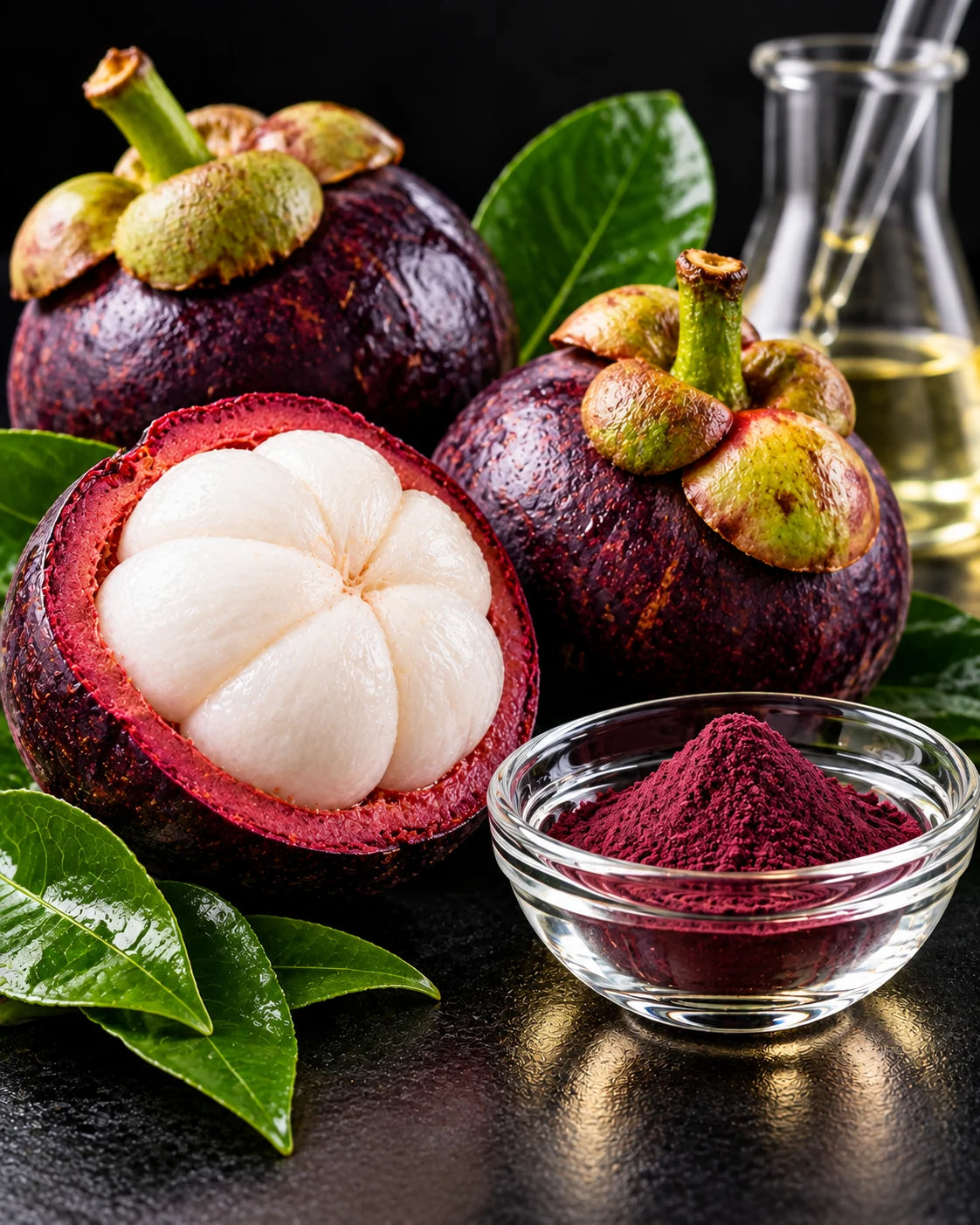
It is also CannonBalm’s hero botanical — the plant the brand was built around and the reason mangosteen appears in our logo. ULTIMATE and MUSCLE-AID both carry it as whole fruit, a concentrated rind extract and liposomal mangosteen.
Whole mangosteen · mangosteen extract · liposomal mangosteen
In the balm: Whole mangosteen, mangosteen extract and liposomal mangosteen in ULTIMATE and MUSCLE-AID.
On this page
Why mangosteen sits at the heart of CannonBalm
I know pain. I have lived with severe chronic pain for most of my life.
Long before CannonBalm existed, that experience pushed me deeply into studying natural therapies and the extraordinary biologically active compounds found in plants. By 2016, after years of severe pain and heavy reliance on conventional pain treatments, I had become seriously unwell. That period transformed a long-standing interest into something much deeper: a determination to understand what nature could offer and why.
Mangosteen became one of the plants I could not stop studying.
I have been studying and using mangosteen for close to two decades, and it has been at the centre of CannonBalm from the beginning. More than five years of developing products with it has only made the questions more interesting: Which part of the fruit matters? Which xanthones matter? What happens when those compounds meet skin? And how much more of mangosteen’s biology can we capture by using the whole fruit, a concentrated extract and a liposomal form together?
The deeper we have gone, the more remarkable the chemistry has become. The deep-purple pericarp — the thick rind surrounding the edible white flesh — contains an extraordinary family of compounds called xanthones. Researchers have identified at least 68 distinct xanthones across Garcinia mangostana, with approximately 50 reported in the pericarp.
That is where ULTIMATE and MUSCLE-AID start.
At a glance
Botanical — Garcinia mangostana L.
Forms in the balm — whole mangosteen · mangosteen extract · liposomal mangosteen
Products — ULTIMATE · MUSCLE-AID
Chemical family — Prenylated xanthones
Major xanthones — α-Mangostin · γ-mangostin · β-mangostin
Other characterised xanthones — Gartanin · 8-deoxygartanin · garcinones A–E · mangostinone · 9-hydroxycalabaxanthone · isomangostin and many more
Joint and cartilage biology — NF-κB · COX/PGE₂ · MMP-3/-9/-13 · ADAMTS-5 · collagen II · aggrecan · SOX-9
Muscle biology — myoblast differentiation · myotube formation · MyoD · myogenin
Skin sensory biology — TRPV3
Human evidence — randomised human topical research · symptomatic knee-osteoarthritis trial of a mangosteen-containing cream · human muscle-soreness and recovery research
Mangosteen has been studied directly on human skin
Can mangosteen-rind chemistry be formulated for human skin and produce measurable effects?
A 12-week, randomised, double-blind, split-face clinical study enrolled 28 adults with mild-to-moderate acne. One side received a nanoparticle-loaded gel containing 0.5% mangosteen fruit-rind extract. The other received 1% clindamycin gel. Both sides received the same brief background benzoyl-peroxide treatment.
After 12 weeks, the mangosteen-treated side showed:
66.86% reduction in comedonal lesions
67.05% reduction in inflammatory lesions
Significant improvement was evident from two weeks. For topical formulation science this is highly relevant: mangosteen fruit-rind extract was applied directly to human skin in a controlled clinical experiment and produced substantial measurable changes.
Read the 28-person randomised human topical study →
The joint and cartilage science
This is where mangosteen becomes particularly interesting. α-Mangostin has been investigated directly in experimental osteoarthritis, cartilage inflammation and extracellular-matrix degradation.
In interleukin-1β-stimulated articular chondrocytes, α-mangostin reduced prostaglandin E₂ (PGE₂), nitric oxide, inducible nitric oxide synthase (iNOS), cyclooxygenase-2 (COX-2), and matrix metalloproteinases MMP-3, MMP-9 and MMP-13. At the same time, researchers observed protection of type-II collagen and aggrecan — two fundamental components of healthy cartilage matrix.
α-Mangostin also suppressed activation of the nuclear factor kappa B (NF-κB) pathway. Moving into an experimental osteoarthritis model, animals receiving α-mangostin showed less cartilage degeneration and lower OARSI histological scores.
Read the α-mangostin osteoarthritis and cartilage research →
MMP-13. ADAMTS-5. Collagen. Aggrecan.
A second osteoarthritis study found α-mangostin reduced MMP-13 and ADAMTS-5, increased SOX-9, reduced chondrocyte apoptosis and slowed osteoarthritis progression in the experimental model. MMP-13 is a major collagen-degrading enzyme; ADAMTS-5 is one of the major aggrecan-degrading enzymes; SOX-9 is a central transcription factor in healthy cartilage biology.
NF-κB → COX/PGE₂ → MMP-13 → ADAMTS-5 → collagen II + aggrecan
A much deeper biological story than a generic antioxidant fruit.
Read the MMP-13 / ADAMTS-5 / SOX-9 osteoarthritis research →
Human knee osteoarthritis research
A four-week randomised controlled trial enrolled 199 people with symptomatic knee osteoarthritis and moderate knee pain. Researchers compared diclofenac gel with Thai Medicinal Plant-4 cream, a topical formula containing Garcinia mangostana peel, Sesamum indicum seed, Glycine max seed and Centella asiatica leaf.
The mean change in knee-pain visual analogue scale was:
−31.68 mm with the mangosteen-containing botanical cream
−31.09 mm with diclofenac gel
The trial met its predefined criterion for noninferiority, and safety outcomes were comparable between the interventions — a particularly interesting piece of controlled human research involving topically applied mangosteen peel.
Read the 199-person knee osteoarthritis trial →
Mangosteen and working muscle
A hard training session, a long day of physical work or overworked muscles involve more than one biological process: local inflammatory signalling, oxidative stress, changes in energy metabolism, and repair, remodelling and adaptation. That is why mangosteen sits at the centre of MUSCLE-AID as well as ULTIMATE.
In skeletal-muscle-derived C2C12 myoblasts, α-mangostin enhanced myogenic differentiation, increased myotube formation and increased expression of MyoD and myogenin — two master regulators of muscle-cell development.
Read the α-mangostin myoblast research →
A randomised, double-blind crossover study then looked at recovery after demanding eccentric exercise. Participants receiving a polyphenol-rich blend containing mangosteen showed:
33% REDUCTION IN PERCEIVED MUSCLE SORENESS AT 24 HOURS
Researchers also reported lower levels of several muscle-damage-associated markers during recovery. And in a 42-day randomised, double-blind, placebo-controlled study of 38 resistance-trained men, a botanical blend containing mangosteen fruit-rind extract was associated with greater improvements in muscle strength and endurance.
Read the muscle-soreness and recovery study →
Read the resistance-training study →
Human research has also looked at mangosteen in people dealing with soft-tissue pain. A 2015 pilot clinical investigation included athletic and older volunteers with acute or chronic soft-tissue complaints, and a mangosteen extract rich in α- and γ-mangostins was associated with a significant reduction in reported soft-tissue pain over the short study period.
Read the mangosteen soft-tissue pain pilot →
From myoblast to myotube
Skeletal muscle is constantly adapting. Training, physical work and repeated load trigger repair, remodelling and adaptation, with myogenic precursor cells differentiating into multinucleated muscle fibres. The α-mangostin research intersects that process at several points: α-mangostin → myoblast differentiation → MyoD + myogenin → myotube formation.
A botanical famous for its inflammatory chemistry — with a direct connection to muscle-cell biology too.
Why the pericarp matters
Cut open a mangosteen and most people notice the soft white flesh. Scientifically, the deep-purple rind is where things become much more interesting. The pericarp is extraordinarily rich in the fruit’s characteristic xanthones.
One HPLC-DAD-MS analysis quantified α-mangostin at approximately 3.32% of dried pericarp, against approximately 0.21% in the dried edible aril — more than a 15-fold difference. γ-Mangostin showed close to a 20-fold difference.
MORE THAN 15× THE α-MANGOSTIN IN THE RIND
That is why whole mangosteen — rind and all — and a rind-rich extract bring so much more than the flesh alone.
Read the pericarp-versus-aril xanthone analysis →
Mangosteen is a family of xanthones
Mangosteen pericarp contains an extraordinary spectrum including α-mangostin, γ-mangostin, β-mangostin, gartanin, 8-deoxygartanin, garcinones A–E, mangostinone, 9-hydroxycalabaxanthone, isomangostin, mangostanol, garciniafuran and dozens more.
A recent HPLC analysis quantified eight xanthones directly in dried pericarp. α-Mangostin dominated at 58.08 mg/g, followed by γ-mangostin at 8.03 mg/g, with gartanin, 9-hydroxycalabaxanthone, garcinone D, 8-deoxygartanin, garcinone C and β-mangostin also identified.
These compounds belong to the same chemical family — each with its own biology. That is where the broader mangosteen story becomes fascinating.
Different xanthones. Different biology.
α-Mangostin
The dominant and most extensively researched mangosteen xanthone. Its research reaches across NF-κB, COX-2, PGE₂, TNF-α, IL-1β, IL-6, NLRP3, IL-18, TRPV3, MMP-3, MMP-9, MMP-13 and ADAMTS-5.
γ-Mangostin
In direct enzyme experiments, γ-mangostin inhibited COX-1 at an IC₅₀ of approximately 0.8 μM and COX-2 at approximately 2 μM, and reduced PGE₂ production.
Read the γ-mangostin COX/PGE₂ research →
β-Mangostin
Experimental research reported reductions in PGE₂, TNF-α, IL-6, IL-1β and leukocyte migration, together with COX-2 inhibition and suppression of NF-κB nuclear translocation.
Read the β-mangostin research →
One topical experimental study directly compared whole mangosteen pericarp extract with isolated α-mangostin. The complete extract markedly reduced TNF-α, IL-6, IL-1β and TLR-2 and produced more complete epidermal recovery.
That is exactly why we use the whole fruit, the extract and the liposomal form together.
Read the whole-pericarp versus isolated α-mangostin research →
Garcinone C and Garcinone D
Even some of the less famous mangosteen xanthones are producing fascinating results. Recent research found garcinone C and garcinone D reduced inflammatory nitric-oxide signalling and iNOS expression, and activated Nrf2, with increases in the cellular-defence proteins HO-1, NQO1 and GSTP1. There is still more chemistry being discovered inside this fruit.
Read the garcinone C and D research →
The pathway science
NF-κB — one of inflammation’s central control systems
α-, γ- and β-mangostin all intersect NF-κB, a master regulator of inflammatory gene expression. Three different mangosteen xanthones converging on one major inflammatory signalling system.
MAPK and AP-1
In primary human adipocytes, α- and γ-mangostin reduced activation of JNK, ERK, p38 MAPK, c-Jun and AP-1 while reducing inflammatory genes including TNF-α, IL-1β, IL-6 and IL-8.
Read the human-cell MAPK research →
COX and PGE₂ — a classic pain and inflammation pathway
Cyclooxygenase enzymes sit at the centre of prostaglandin production, and PGE₂ plays an important role in inflammatory pain sensitisation. Mangosteen xanthones intersect this system from several directions: γ-mangostin directly inhibited COX-1 and COX-2 and reduced PGE₂ production; α-mangostin reduced PGE₂ and COX-2-associated activity alongside other inflammatory signals; β-mangostin has also reduced PGE₂.
α. γ. β. Three mangosteen xanthones converging on prostaglandin biology.
NLRP3 — inflammasome biology
In human cells exposed to inflammatory stimulation, α-mangostin reduced NLRP3, ASC, pro-caspase-1, IL-1β and IL-18 and improved cell viability.
TRPV3 — mangosteen meets skin sensory biology
TRPV3 is an ion channel strongly expressed in keratinocytes, the predominant cells of the epidermis. In 2023, researchers identified α-mangostin as a potent TRPV3 inhibitor, with a reported IC₅₀ of 0.077 ± 0.013 μM — a fascinating connection between mangosteen and the sensory biology of skin itself.
Read the α-mangostin/TRPV3 research →
Topical skin research
Direct topical experimental work adds another layer. In a superficial-skin model, mangosteen pericarp extract reduced bacterial counts, improved transepidermal-water-loss measurements and accelerated recovery of damaged skin. Later work found whole pericarp extract reduced TNF-α, IL-6, IL-1β and TLR-2 and produced more complete epidermal recovery — and across several measurements the complete extract performed more strongly than isolated α-mangostin.
The complete fruit chemistry, working together.
Delivery matters
α-Mangostin is highly lipophilic, so the surrounding vehicle has a major effect on its solubility, partitioning, skin permeation and tissue retention. Researchers comparing formulations in skin found α-mangostin permeation increased by approximately 1.8- to 8.0-fold, and deposition in viable epidermis and dermis by approximately 2.5- to 2.9-fold, depending on the carrier.
Formulation shapes what mangosteen chemistry does at the skin.
That is why both balms carry mangosteen in a rich oil-and-wax base — and in liposomal form.
Read the α-mangostin skin-permeation research →
More human topical and local-delivery research
Another investigation used α-mangostin nanoparticles designed to deposit around hair follicles and sebaceous structures. A two-week, twice-daily application test in 20 healthy volunteers found insignificant skin irritation, and researchers detected α-mangostin at the roots of hairs removed from treated skin.
α-Mangostin can be delivered into human skin — and the vehicle shapes where it goes.
Read the human follicular-delivery research →
Mangosteen has also been studied as a locally delivered gel in human periodontal tissue, where randomised trials using 4% mangosteen gel reported improvements in periodontal measures compared with control treatment — adding to a substantial human local-delivery literature around mangosteen.
Read the mangosteen periodontal systematic review →
Whole fruit, extract and liposomal mangosteen
Both balms carry mangosteen in three complementary forms. The whole fruit brings the complete family of xanthones working together — and research comparing whole pericarp extract with isolated α-mangostin found the complete extract performed more strongly. The concentrated rind extract focuses α-mangostin, the most researched xanthone of all. And liposomal mangosteen carries that chemistry in a phospholipid carrier designed for skin.
Explore Liposomal Botanicals →
One fruit. At least 68 xanthones.
Mangosteen has been at the heart of CannonBalm from the beginning. α-Mangostin has exceptional research depth. γ-Mangostin brings powerful COX/PGE₂ science. β-Mangostin adds another distinct profile. And the research now reaches from cartilage and skin into working muscle.
That is why mangosteen sits at the centre of ULTIMATE and MUSCLE-AID — for sore joints, hard-working muscles and the inflammatory pathways that keep pain switched on.
Selected authoritative research
Mangosteen xanthone diversity
Gutierrez-Orozco F, Failla ML. Nutrients. 2013. PMID 23945675. PMCID PMC3775248.
α-Mangostin in experimental osteoarthritis
Cartilage, NF-κB, MMPs, collagen II and aggrecan. PMID 28858724.
MMP-13, ADAMTS-5, SOX-9 and osteoarthritis progression
199-person randomised knee-osteoarthritis trial
Mangosteen-containing TMP-4 botanical cream versus diclofenac gel. PMID 35733624. PMCID PMC9208949.
12-week randomised double-blind topical mangosteen-rind study
28 adults · 0.5% mangosteen fruit-rind extract nanoparticle gel. PMID 30688020.
α-Mangostin, MyoD and myogenin
Lin M, Zhou S, Sakamoto K. Biochemical and Biophysical Research Communications. 2020. PMID 32475640.
α-Mangostin and myoblast differentiation
Horiba T et al. Bioscience, Biotechnology, and Biochemistry. 2014. PMID 25060354.
Delayed-onset muscle soreness and recovery
Romain C et al. Phytotherapy Research. 2017. PMID 28856749.
Resistance-trained men
α- and γ-mangostin in primary human adipocytes
JNK/ERK/p38 MAPK · AP-1 · NF-κB. PMID 19403722.
γ-Mangostin — COX-1/COX-2 and PGE₂
Nakatani K et al. Biochemical Pharmacology. 2002. PMID 11754876.
β-Mangostin — COX-2, PGE₂, NF-κB and cytokines
α-Mangostin — NLRP3 / NF-κB
α-Mangostin — TRPV3 inhibition in keratinocytes
Reported IC₅₀ 0.077 ± 0.013 μM. PMID 37629111.
Whole pericarp extract versus isolated α-mangostin
TNF-α · IL-6 · IL-1β · TLR-2 · healing outcomes. PMID 30611995.
α-Mangostin human follicular delivery
Pan-In P et al. Journal of Pharmacological Sciences. 2015. PMID 26701606.
Mangosteen periodontal research — systematic review
Garcinone C and D — Nrf2, HO-1, NQO1 and GSTP1
Tocmo et al. Nutrients. 2026. PMID 41683359.
Pericarp versus edible-aril xanthones
Wittenauer J et al. Food Chemistry. 2012.
Where Science Meets Nature.
Mangosteen is exactly what that means.
Nearly two decades after it first captured my attention, we are still learning more about what sits inside that dark-purple rind.