
CLOVE BUD ESSENTIAL OIL
Target pain signalling at the source.
Clove is one of the most recognisable medicinal spices on earth — the oil people have dabbed on a sore tooth for generations because it numbs and soothes. In ULTIMATE and MUSCLE-AID it earns its place through modern pain science.
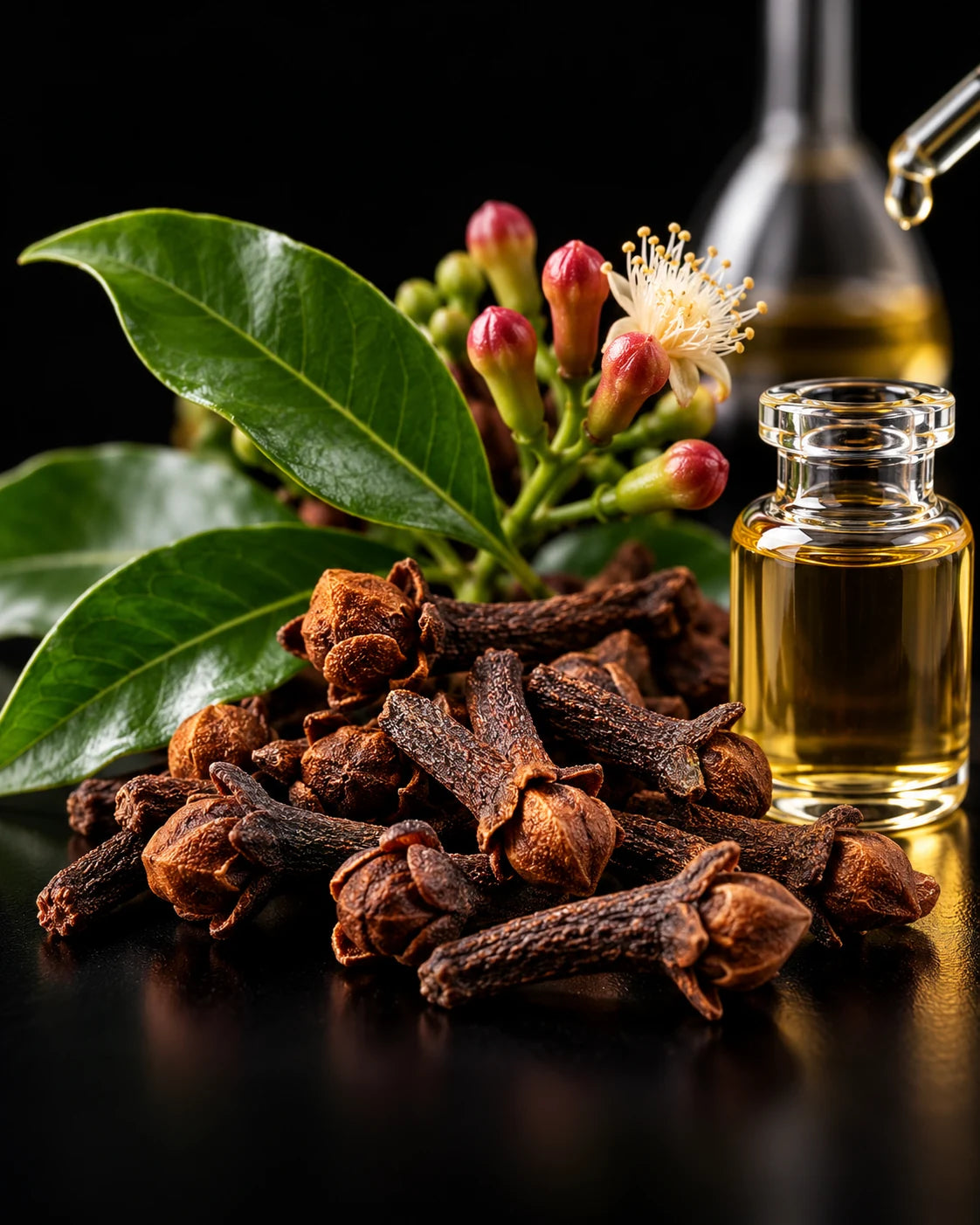
We use eugenol-rich clove bud essential oil because modern research shows eugenol interacts directly with several of the ion channels and sensory receptors that control peripheral pain signalling: voltage-gated sodium channels, calcium channels, P2X3, TRPV1 and TRPA1. These are the same channels local anaesthetics act on — which is why clove brings fast, soothing, numbing-style comfort where the balm is applied. Clove is the largest essential oil in ULTIMATE and balances MUSCLE-AID’s cooling peppermint.
Clove bud essential oil · certified organic
In the balm: Clove bud essential oil in ULTIMATE (the formula’s largest essential oil) and MUSCLE-AID.
On this page
At a glance
Botanical — Syzygium aromaticum · Plant part — Flower bud · Material — Clove bud essential oil · Certified organic
Products — ULTIMATE · MUSCLE-AID
Major sensory targets — Voltage-gated Na⁺ channels · CaV2.2 · CaV2.3 · T-type Ca²⁺ channels · P2X3 · TRPV1 · TRPA1
Inflammatory research — COX-2 · PGE₂ · IL-1β · TNF-α · iNOS/NO
Human topical evidence — Whole-clove-oil topical anaesthesia studies · 4% topical eugenol randomised crossover pain trial
Skin-delivery research — Eugenol delivery into intact human dermis demonstrated with a topical carrier system
Clove oil itself has been tested on pain in people
A randomised clinical trial published in July 2026 compared topical clove oil · EMLA 5% · lignocaine hydrochloride gel 2%. before local-anaesthetic injection in children aged 7–10. Pain was assessed using both subjective and objective scales. All three topical treatments reduced pain.
Clove oil and EMLA showed comparable effectiveness in the study — numbing comfort from a plant oil, measured against a medical anaesthetic cream.
Read the 2026 randomised clove-oil study on PubMed →
That is direct human evidence using clove oil itself.
Clove versus benzocaine
A classic randomised human trial took this a step further. Researchers applied four topical preparations to the maxillary canine buccal mucosa of 73 adults:
clove gel · 20% benzocaine gel · clove-like placebo · benzocaine-like placebo After five minutes, each participant received two needle sticks and rated pain on a 100-mm visual analogue scale. Both clove and 20% benzocaine produced significantly lower pain scores than their placebos. And there was no significant difference between clove and benzocaine in pain scores.
Read the randomised clove-versus-benzocaine study on PubMed →
Clove has genuine randomised human topical-anaesthetic research — numbing comfort, measured head-to-head.
A randomised skin study with 4% topical eugenol
There is also a particularly relevant intact-skin trial using eugenol itself. Researchers conducted a randomised, double-blind, controlled crossover trial in people undergoing repeated haemodialysis needle insertion.
A topical nanoemulsion gel containing 4% eugenol was applied to the skin around the needle site. After 10 minutes, cannulation was performed. Pain was measured immediately afterwards using a visual analogue scale.
Across the crossover conditions, the lowest mean pain score occurred with eugenol: 3.29 ± 0.67, compared with 5.03 ± 0.57 in the no-intervention condition, with a significant difference across the three study states.
Read the randomised topical-eugenol trial on PubMed →
That is direct human pain research through topical application to intact skin — comfort where it is applied.
Whole clove gel has also been studied in people
A randomised study involving 60 children compared 2% lignocaine gel · 4.7% clove gel · ice · 10% betel-leaf gel before dental injection. Clove was directly tested as a topical pre-anaesthetic preparation in this randomised clinical setting. In this particular trial, lignocaine produced lower pain scores than clove, so the study is useful as human topical context rather than a positive comparator win.
Read the randomised 4.7% clove-gel study on PubMed →
Eugenol pain research reaches well beyond skin
There is also a larger body of human local-pain research from dentistry. In a randomised clinical trial involving 35 patients with alveolar osteitis, eugenol applied locally on gauze significantly reduced pain in the immediate post-treatment period, with strong immediate pain improvement.
Read the randomised alveolar-osteitis trial on PubMed →
A more recent randomised clinical trial involving 100 patients with irreversible pulpitis compared eugenol and articaine after emergency pulpotomy. Both treatments reduced pain, with the eugenol group showing the larger day-one reduction in that study.
Read the randomised eugenol pulpitis trial on PubMed →
Different anatomical contexts — and the same deep history as a local, soothing, pain-active molecule.
Clove also has experimental arthritis research
A 2026 study examined clove essential oil and eugenol across neutrophil-function assays and an experimental arthritis model. Both materials reduced inflammatory activity in vitro, and in the arthritis model they reduced paw oedema and histopathological damage.
It gives clove a direct joint-relevant evidence layer alongside its human topical pain data.
Read the 2026 clove arthritis study →
How clove works alongside peppermint, bergamot and magnesium
The balms’ sensory system is deliberately layered, and each partner brings comfort from a different direction. Peppermint brings menthol and TRPM8 — a fast, clean cooling that changes how pain is sensed. Bergamot and bergamot mint bring linalool, linalyl acetate and limonene — research reaching opioid and glutamate pain signalling and calming peripheral nerve excitability. Magnesium brings its well-studied muscle and pain biology, including its gatekeeper role at the NMDA receptor.
Clove brings what none of them does: direct, local-anaesthetic-style action on the electrical machinery of pain — electrical excitability through voltage-gated Na⁺ channels · presynaptic calcium signalling through CaV2.2 and CaV2.3 · low-threshold sensory excitability through CaV3.1, CaV3.2 and CaV3.3 · ATP-driven pain signalling through P2X3 · and the TRPV1 and TRPA1 sensory channels.
Cooling from peppermint. Calm from bergamot. Numbing comfort from clove. Three forms of magnesium alongside.
In ULTIMATE, clove is the largest essential oil — the backbone of the blend. In MUSCLE-AID, it balances a more peppermint- and bergamot-mint-forward blend built for hard-working muscles.
Each oil fills a specific role. Together they target pain signalling from several directions at once.
Now look underneath the clinical effect
The interesting question is:
How can a plant oil alter pain perception so quickly? Modern electrophysiology gives a remarkably detailed answer. Pain signals are electrical. Sensory neurons must: depolarise · generate action potentials · conduct those signals along nerves · release neurotransmitters at their terminals Eugenol interacts with several of the ion channels needed to make that happen.
Voltage-gated sodium channels — interrupting the electrical signal
Voltage-gated sodium channels are fundamental to action-potential generation and propagation. Local anaesthetics such as lidocaine work largely by suppressing sodium-channel-dependent nerve conduction. Eugenol has been studied directly against these channels.
In rat dental primary-afferent neurons, eugenol inhibited: action potentials · tetrodotoxin-sensitive sodium currents · tetrodotoxin-resistant sodium currents The effect occurred in both capsaicin-sensitive and capsaicin-insensitive neurons and was independent of TRPV1 activation.
Read the sodium-channel study on PubMed →
This gives clove’s principal constituent a direct connection to one of the most fundamental mechanisms in peripheral nerve signalling:
Na⁺ current → action potential → pain transmission
The same effect appears in dorsal-root sensory neurons
The numbing story reaches well beyond dental nerves. Researchers also studied acutely isolated rat dorsal-root-ganglion neurons — the sensory neurons serving the body. Eugenol concentration-dependently inhibited both: TTX-sensitive Na⁺ currents · TTX-resistant Na⁺ currents · with reported dissociation constants of approximately: 308 μM · 543 μM
It shifted channel inactivation and slowed recovery from inactivation — making sodium channels less available for repeated neuronal firing.
Read the dorsal-root sodium-channel study on PubMed →
That extends the local-anaesthetic-style mechanism from tooth pulp into broader peripheral sensory neurons.
Eugenol behaves like a local anaesthetic in a trigeminal pain system
Researchers then connected the electrophysiology to actual nociceptive behaviour and nerve conduction. In a trigeminal pain model, eugenol: reduced thermal nociception · reduced capsaicin-induced thermal hyperalgesia · reduced electrically evoked pain-related muscle activity · blocked action-potential conduction in the inferior alveolar nerve
At the cellular level, it again inhibited voltage-gated sodium currents in multiple classes of nociceptive trigeminal neurons.
Read the local-anaesthetic mechanism paper in Pain on PubMed →
This is one of the cleanest mechanistic bridges in the clove story — and the reason clove soothes the way a local anaesthetic does: ion channel → nerve conduction → pain behaviour
Calcium channels — controlling transmitter release
Sodium channels generate and conduct action potentials. Calcium channels help sensory nerve endings translate those electrical events into chemical neurotransmitter release. Eugenol also interacts with these. In identified dental primary-afferent neurons, eugenol inhibited high-voltage-activated calcium currents in both capsaicin-sensitive and capsaicin-insensitive neurons.
It also directly inhibited: human N-type CaV2.2 calcium channels
in an expression system without TRPV1.
Read the N-type calcium-channel study on PubMed →
N-type calcium channels are particularly important at presynaptic nerve terminals because calcium entry drives neurotransmitter release. That gives eugenol another route into peripheral pain transmission.
CaV2.3 — another calcium-channel target
The same research group investigated human CaV2.3 channels. Eugenol inhibited CaV2.3 currents directly. The effect remained when TRPV1 was absent, showing that this calcium-channel interaction was mechanistically distinct from eugenol’s vanilloid-receptor biology.
Read the CaV2.3 study on PubMed →
T-type calcium channels as well
Eugenol has also been tested against all three major cloned T-type calcium-channel isoforms: CaV3.1 · CaV3.2 · CaV3.3 · It concentration-dependently inhibited each one, with reported IC₅₀ values of approximately: 463 μM — CaV3.1 · 486 μM — CaV3.2 · 708 μM — CaV3.3 T-type currents recorded from trigeminal neurons showed similar sensitivity.
Read the T-type calcium-channel study on PubMed →
So eugenol’s ion-channel story spans multiple pieces of the peripheral excitability machinery — more ways to quiet pain signalling.
P2X3 — ATP as a pain signal
When tissue is injured or inflamed, extracellular ATP can activate sensory neurons.
One important receptor is: P2X3
P2X3 is strongly expressed in nociceptive sensory neurons. Researchers exposed rat trigeminal neurons and P2X3-expressing human-cell systems to ATP. Eugenol inhibited: ATP-induced electrical currents · P2X3-mediated calcium responses
and did so independently of TRPV1.
Read the P2X3 study on PubMed →
That adds a completely different pain-sensing system: ATP → P2X3 → sensory excitation
and eugenol inhibits it.
TRPV1 — sophisticated, mode-selective modulation
TRPV1 is the famous capsaicin-sensitive ion channel involved in: heat · acid · inflammatory sensitisation · burning pain
Eugenol is structurally related to vanilloid compounds and interacts with TRPV1. But the biology is surprisingly nuanced. A 2021 electrophysiology study found that eugenol behaved differently depending on how TRPV1 was activated. It dose-dependently inhibited capsaicin-activated TRPV1 currents.
Under acidic conditions, lower concentrations could enhance proton-activated currents, while higher concentrations produced initial potentiation followed by strong inhibition. It had little effect on heat-activated TRPV1.
Read the mode-selective TRPV1 study on PubMed →
Eugenol fine-tunes TRPV1 according to how the channel is activated — sophisticated sensory pharmacology, and part of how clove calms burning, heat-type discomfort.
TRPA1 — the other side of the sensory experience
Clove’s rich warmth has a molecular reason. TRPA1 is an irritant-sensitive ion channel expressed in nociceptive sensory neurons. Eugenol robustly activated TRPA1 in trigeminal neurons and in human TRPA1-expressing cells.
Read the eugenol / TRPA1 study on PubMed →
Experimental work has also shown that eugenol excites subsets of trigeminal and dorsal-root sensory neurons and can transiently enhance heat responses before desensitisation develops.
Read the trigeminal sensory-neuron study on PubMed →
That explains clove’s signature on the skin: an initial rich warmth, followed by its deeper soothing, local-analgesic action.
This is peripheral sensory pharmacology
Put those mechanisms together.
Eugenol interacts experimentally with: NaV sodium channels · CaV2.2 · CaV2.3 · CaV3.x · P2X3 · TRPV1 · TRPA1
These systems control different stages of nociception: stimulus detection · membrane excitability · action-potential firing · nerve conduction · calcium entry · neurotransmitter release.
Target pain signalling at the source.
And there is inflammatory biology underneath it too
Clove’s contribution reaches beyond neural signalling. Eugenol has also been investigated against inflammatory mediators. In LPS-stimulated human macrophage-like cells, eugenol reduced release of: IL-1β · TNF-α · PGE₂ · and suppressed expression of: COX-2 mRNA
Read the human-macrophage eugenol study on PubMed →
That pairs naturally with pomegranate and mangosteen, whose research also reaches COX and PGE₂ biology — the same inflammatory pathway approached from several directions.
PGE₂ inhibition can be potent in experimental systems
A bioassay-guided clove investigation isolated eugenol as an active constituent. In LPS-activated macrophages, eugenol inhibited: PGE₂ production · with a reported: IC₅₀ of 0.37 μM
and suppressed COX-2 gene expression.
Read the COX-2 / PGE₂ eugenol study on PubMed →
Classic enzyme work also found that eugenol could directly inhibit the cyclooxygenase component of prostaglandin-H synthase under defined biochemical conditions.
Read the prostaglandin-H-synthase mechanism study on PubMed →
Nitric oxide and iNOS
Activated macrophage research found eugenol reduced LPS-dependent nitric-oxide production through suppression of inducible nitric-oxide synthase — iNOS — synthesis. COX-2 expression was also reduced under those experimental conditions.
Read the eugenol / iNOS study on PubMed →
Again, this places eugenol at the intersection of: sensory signalling · and
inflammatory mediator biology.
Clove bud oil — the eugenol-rich part of the plant
The accepted botanical is: Syzygium aromaticum (L.) Merr. & L.M.Perry Kew lists Syzygium aromaticum as the accepted species and identifies the familiar clove as its dried aromatic flower bud.
Check the accepted Syzygium aromaticum record at Kew →
Clove bud oil is the premium, eugenol-rich material — distinct from clove leaf or stem oil. Its volatile chemistry varies with origin, harvest and distillation, and eugenol consistently dominates high-quality clove bud oils. A modern review of clove essential oil reported eugenol as the principal constituent, with eugenyl acetate, β-caryophyllene and α-humulene contributing much of the remainder.
Read the modern clove-essential-oil composition review on PubMed →
Published GC-MS analyses of clove bud essential oil have measured strongly eugenol-dominant profiles. One measured: 73.41% eugenol
Read the 73.41% clove-bud GC-MS study on PubMed →
Another modern analysis measured: 76.78% eugenol
Read the 76.78% clove-oil GC-MS study on PubMed →
The whole oil brings more
Whole clove bud oil brings more than eugenol. Alongside its dominant eugenol, it also contains meaningful quantities of:
β-caryophyllene · eugenyl acetate · α-humulene
plus a broader set of minor constituents.
Read the clove essential-oil chemistry review on PMC →
Published clove-oil samples show the full natural profile.
For example, one modern GC-MS study reported: 76.78% eugenol · 21.24% β-caryophyllene
Read the 76.78% eugenol GC-MS paper on PubMed →
That is why the balms use the whole clove bud essential oil. The eugenol research explains much of the pain pharmacology; the complete oil brings the full natural chemistry with it.
Eugenol can reach human dermis
Delivery matters here too. Researchers developed a topical eugenol carrier and applied it to intact human skin. After 12 hours, eugenol-loaded particles were detected penetrating into the dermis — and the carrier architecture shaped both delivery and skin comfort.
Read the intact-human-skin eugenol delivery study on PubMed →
It demonstrates that a well-designed eugenol-containing system can carry the material beyond the skin surface.
The vehicle changes skin exposure
Franz-cell experiments have also shown that vehicle design changes both eugenol permeation and retention in skin. In comparative gel and cream systems, gel vehicles produced the greatest eugenol skin accumulation in the experimental model.
Read the eugenol skin-retention study on PubMed →
Other transdermal research has also used clove oil as a permeation enhancer. That makes clove valuable twice: as an active, soothing sensory oil · and
as part of the broader lipid-phase delivery environment.
The sensory effect is part of the benefit
Clove has a presence you can feel. Its principal constituent interacts with both TRPV1 and TRPA1 while simultaneously suppressing sodium and calcium currents. The same molecule therefore brings: initial sensory activation · rich warmth · sensory desensitisation · reduced neuronal excitability
That is why finished-formula balance matters so much with a powerful oil like clove — and why both balms pair it with cooling peppermint, bergamot and a rich, soothing oil-and-wax base. The goal is functional sensory pharmacology inside a comfortable finished balm.
Clove inside the balms’ pathway architecture
Human topical/local pain — Clove oil vs EMLA/lignocaine · clove vs benzocaine · topical 4% eugenol crossover trial
Nerve excitability — TTX-sensitive and TTX-resistant Na⁺ currents · Nerve conduction — Action-potential propagation · Calcium signalling — CaV2.2 · CaV2.3 · CaV3.1/3.2/3.3 · ATP pain signalling — P2X3 · Heat / vanilloid biology — TRPV1 · Irritant sensory biology — TRPA1 · Prostaglandin biology — COX-2 · PGE₂ · Inflammatory cytokines — IL-1β · TNF-α
Nitric-oxide biology — iNOS · NO · Skin delivery — Intact-human-skin dermal delivery · Franz-cell skin retention
A role no other ingredient in the balms fills — and exactly the type of complementary biology both balms are built around.
Technical summary
Ingredient — Syzygium aromaticum clove bud essential oil · Plant part — Flower bud · Dominant constituent — Eugenol · Products — ULTIMATE (largest essential oil) · MUSCLE-AID
Published clove-oil composition — Eugenol commonly dominant; multiple published oils approximately 65–89%, with substantial variability by material and process
Other common constituents — β-caryophyllene · eugenyl acetate · α-humulene · Whole-oil human evidence — Randomised clove-oil / clove-gel topical anaesthesia studies
Human skin eugenol evidence — Randomised double-blind crossover 4% topical eugenol nanoemulsion for needle pain
Sodium channels — TTX-sensitive and TTX-resistant currents inhibited · High-voltage Ca²⁺ channels — Dental-afferent HVA currents and human CaV2.2 inhibited · CaV2.3 — Direct inhibitory research · T-type calcium channels — CaV3.1/3.2/3.3 inhibited · Purinergic signalling — ATP/P2X3 currents inhibited · TRPV1 — Mode-selective modulation · TRPA1 — Direct activation demonstrated · Inflammatory pathways — COX-2 · PGE₂ · IL-1β · TNF-α · iNOS/NO
Human dermal delivery — Eugenol-carrier penetration into intact human dermis demonstrated · Vehicle dependence — Skin permeation/retention changes materially with formulation
Selected authoritative research
2026 randomised human clove-oil topical-anaesthesia trial
Clove versus 20% benzocaine
Alqareer A et al. Journal of Dentistry. 2006. PMID 16530911 · DOI 10.1016/j.jdent.2006.01.009.
4% topical eugenol — randomised double-blind crossover human trial
Randomised 4.7% clove-gel human study
Clove essential oil/eugenol — experimental arthritis
El Faqer O et al. Inflammopharmacology. 2026. PMID 41348260 · DOI 10.1007/s10787-025-02061-w.
Eugenol — voltage-gated sodium currents in dental afferents
Park CK et al. Journal of Dental Research. 2006. PMID 16998128 · DOI 10.1177/154405910608501005.
Eugenol — sodium currents in dorsal-root sensory neurons
PMID 18824159 · DOI 10.1016/j.brainres.2008.09.030.
Molecular mechanism for eugenol local-anaesthetic action
Park CK et al. Pain. 2009. PMID 19376653 · DOI 10.1016/j.pain.2009.03.016.
Eugenol — N-type calcium channels
PMID 16109996 · DOI 10.1177/154405910508400913.
Eugenol — CaV2.3 calcium channels
PMID 18218839 · DOI 10.1177/154405910808700201.
Eugenol — T-type calcium channels
PMID 24014106 · PMCID PMC11047949 · DOI 10.1124/jpet.113.207936.
Eugenol — ATP / P2X3 sensory signalling
PMID 19967073 · PMCID PMC2788653 · DOI 10.4196/kjpp.2008.12.6.315.
Eugenol — mode-selective TRPV1 modulation
Eugenol — TRPA1 activation
PMID 24384226 · DOI 10.1016/j.neuroscience.2013.12.047.
Eugenol — trigeminal sensory-neuron activation and desensitisation context
PMID 24759772 · PMCID PMC4070529 · DOI 10.1016/j.neuroscience.2014.04.019.
Human macrophages — COX-2, PGE₂, IL-1β and TNF-α
Eugenol — PGE₂ and COX-2
PMID 12757841. PGE₂ IC₅₀ reported at 0.37 μM in the tested macrophage system.
Prostaglandin-H-synthase / cyclooxygenase mechanism
Eugenol — nitric oxide and iNOS
PMID 16707845 · DOI 10.2220/biomedres.27.69.
Intact-human-skin eugenol delivery
PMID 34746580 · PMCID PMC8567392.
Eugenol skin permeation and retention
PMID 34248621 · PMCID PMC8267472.
Randomised alveolar-osteitis eugenol trial
PMID 20006169 · DOI 10.1016/j.joms.2009.06.033.
Randomised eugenol pulpitis trial
PMID 37504233 · PMCID PMC10377881 · DOI 10.3390/dj11070167.
Clove essential-oil chemistry
Clove-bud essential oil GC-MS — 73.41% eugenol
Clove essential-oil GC-MS — 76.78% eugenol
PMID 36985392 · PMCID PMC10058340.
The clove story is electrical
Clove brings direct peripheral nerve pharmacology — sodium currents · calcium currents · ATP signalling · TRPV1 · TRPA1 · nerve conduction · human topical anaesthesia · human intact-skin eugenol delivery.
And underneath it: COX-2 · PGE₂ · inflammatory cytokines.
Numbing, soothing comfort. Target pain signalling at the source.
Where Science Meets Nature.
Target pain signalling at the source.
Numbing, soothing clove — with direct peripheral sensory pharmacology across sodium currents, calcium currents, ATP signalling, TRPV1 and TRPA1, and COX-2 and PGE₂ underneath it.