
BERGAMOT & BERGAMOT MINT
More than citrus. Pain biology.
Bergamot is famous for its aroma. Behind that distinctive citrus profile is a volatile chemical system dominated by linalool, linalyl acetate and limonene — molecules with research spanning peripheral pain signalling, nerve excitability, inflammatory mediators and topical delivery.
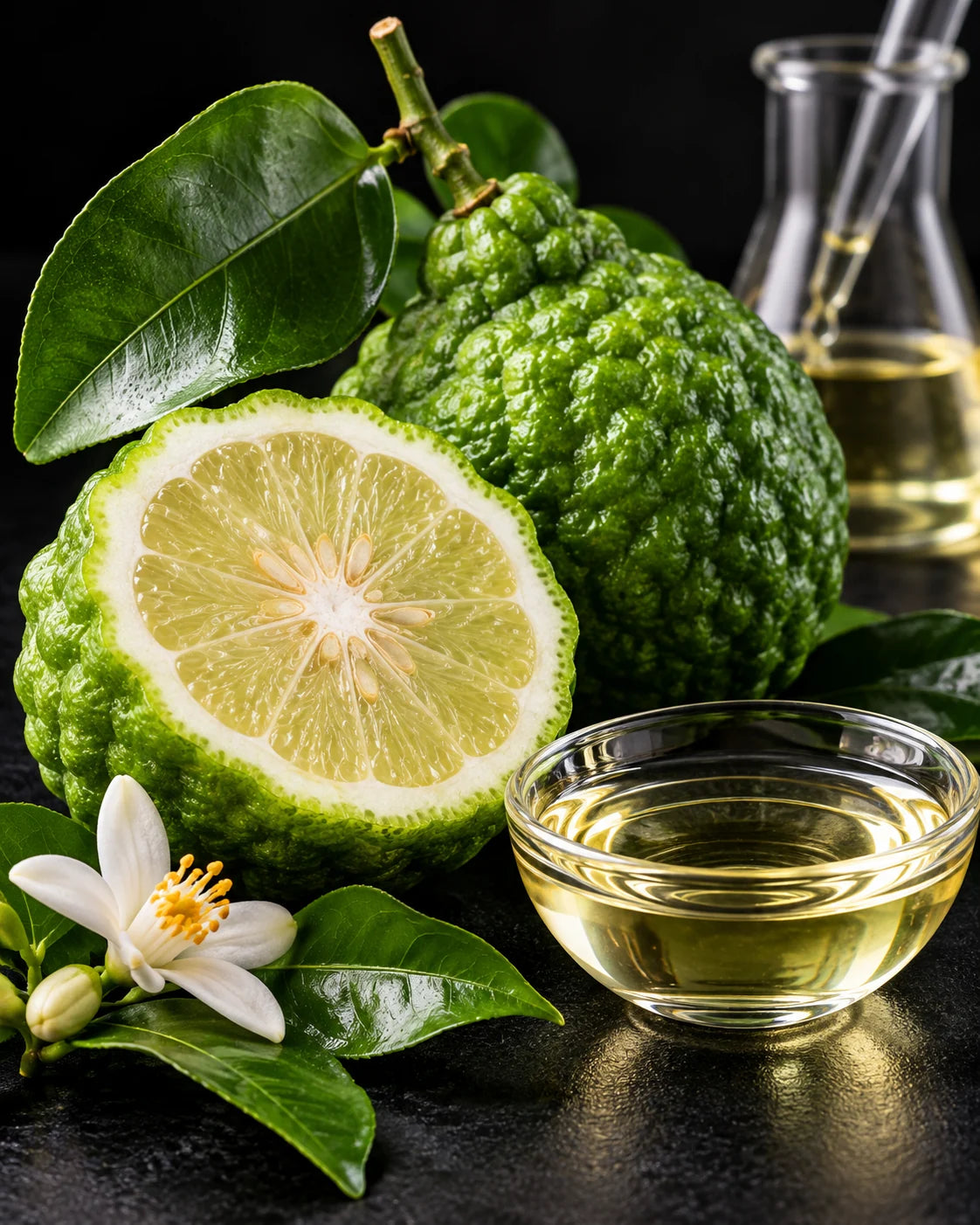
Bergamot mint is a different plant again — a mint with its own linalool and linalyl-acetate-rich chemistry. Together they give ULTIMATE and MUSCLE-AID a softer, complementary sensory pathway alongside menthol and eugenol. MUSCLE-AID is the more bergamot-mint-forward balm; ULTIMATE carries more citrus bergamot.
Bergamot essential oil · bergamot mint essential oil · certified organic
In the balm: Bergamot and bergamot mint essential oils in ULTIMATE and MUSCLE-AID.
On this page
At a glance
Bergamot — Citrus bergamia peel essential oil · certified organic
Bergamot mint — Mentha aquatica var. citrata essential oil · certified organic
Products — ULTIMATE (more bergamot) · MUSCLE-AID (more bergamot mint)
Characteristic chemistry — linalool · linalyl acetate · limonene
Sensory targets — peripheral opioid signalling · voltage-gated Na⁺ and Ca²⁺ channels · TRPA1 · TRPV1
Human joint evidence — randomised knee-osteoarthritis bergamot massage trial
Bergamot has been tested on human knee osteoarthritis
A 2024 randomised controlled study enrolled 60 menopausal women with grade II–III knee osteoarthritis. Participants were randomised into three groups: bergamot essential-oil massage — n=20 · sweet-almond-oil placebo massage — n=20 · control — n=20
All groups received conventional physiotherapy. The bergamot and placebo groups additionally received massage twice weekly for four weeks. Researchers measured: pain · function · sleep quality · menopausal symptoms using established clinical scales including VAS and an osteoarthritis functional index.
Bergamot massage was significantly more effective for pain and function than both placebo massage and control.
Read the randomised knee-OA trial on PubMed →
The study design is especially strong. The placebo group also received massage — with sweet almond oil alone — which highlights the contribution of the bergamot itself. Skin contact plus aroma: a real-world way of using bergamot on a sore knee.
Bergamot on an osteoarthritic knee
Bergamot oil was diluted into sweet almond oil and massaged directly around the affected knee and leg, twice weekly for four weeks,
with the knee then wrapped briefly following massage.
Read the trial protocol and outcomes on PubMed →
That puts bergamot evidence directly onto the knee:
Bergamot essential oil has been incorporated into a local knee intervention in people with diagnosed osteoarthritis — and pain and function improved.
What bergamot adds to both balms
This is where ULTIMATE and MUSCLE-AID become more interesting as systems. Mangosteen and pomegranate carry much of the deep cartilage, MMP and inflammatory-tissue biology. Clove reaches strongly into peripheral ion channels with its numbing, local-anaesthetic-style action. Peppermint brings TRPM8 cooling. Magnesium brings muscle and NMDA pain biology.
Bergamot contributes another layer: human knee-pain evidence · transdermal antinociception · linalool/linalyl-acetate sensory pharmacology · peripheral opioid signalling · TRPA1/TRPV1 · Na⁺ and Ca²⁺ channel biology · PGE₂ and cytokine research — and a fresh, rounded citrus finish.
Why we look at linalool
Bergamot is a complex essential oil — a whole phytocomplex. One of its major naturally occurring constituents is linalool, alongside linalyl acetate and limonene. Researchers have studied linalool directly in several pain-signalling systems, revealing part of the nerve pharmacology sitting inside bergamot oil.
Bergamot, linalool and peripheral opioid signalling
A particularly interesting bergamot study investigated capsaicin-induced pain behaviour. Local bergamot essential oil reduced the nociceptive response in a dose-dependent manner.
So did: linalool · linalyl acetate
The researchers then introduced opioid-receptor antagonists. Naloxone reduced the antinociceptive effects. And a peripherally acting μ-opioid-receptor-preferring antagonist also attenuated the effects of bergamot and linalool. The authors concluded that peripheral opioid mechanisms contributed to bergamot- and linalool-induced antinociception.
Read the bergamot / linalool peripheral-opioid study on PubMed →
That gives bergamot a pathway entirely different from the COX/PGE₂ biology elsewhere in the balms — the body’s own peripheral pain control.
Linalool can suppress peripheral nerve excitability
In rat sciatic nerves and dorsal-root-ganglion sensory neurons, linalool concentration-dependently and reversibly suppressed nerve excitability. It inhibited: compound action potentials · and · voltage-gated Na⁺ currents · The reported compound-action-potential IC₅₀ was approximately: 0.78 mM
The researchers concluded that linalool displayed local-anaesthetic properties through its effects on voltage-dependent sodium channels.
Read the linalool peripheral-nerve study on PubMed →
This puts bergamot’s chemistry into familiar territory after our Clove page: local-anaesthetic-style calming of the sensory nerve. Different molecule.
Same fundamental problem: How excitable is the sensory nerve?
Linalool and glutamatergic pain signalling
Pain signalling is also heavily influenced by excitatory glutamate transmission. Linalool has been studied in pain models triggered by: glutamate · NMDA · AMPA · kainate and significantly reduced nociceptive responses across several of those excitatory systems.
Read the linalool / glutamatergic pain study on PubMed →
Other work has shown linalool can suppress hyperalgesia generated by: carrageenan · glutamate · PGE₂
Read the linalool hyperalgesia study on PubMed →
This broadens the bergamot story beyond local inflammatory chemistry into excitatory sensory processing.
Linalool also targets TRPA1 and calcium channels
More recent electrophysiology has added another layer.
In mouse sensory neurons, linalool suppressed responses to the nociceptive channel: TRPA1 · and inhibited: voltage-gated Ca²⁺ currents
It also reduced TRPA1-mediated pain behaviour in vivo.
Read the linalool / TRPA1 / calcium-channel study on PubMed →
That creates another direct peripheral-sensory connection: TRPA1 + Ca²⁺ channels → nociceptor excitability
Linalool is a calming molecule in more ways than one — and bergamot brings it to the skin.
Then researchers put bergamot directly onto the skin
A 2022 study was specifically designed around transdermal administration. Researchers tested: whole bergamot essential oil · a limonene-enriched fraction · a linalool/linalyl-acetate-enriched fraction · d-limonene · linalool · linalyl acetate
in the formalin pain model.
Rather than inhaling the oils, the researchers applied them: topically to the affected paw
The whole bergamot phytocomplex significantly reduced pain-related licking/biting behaviour in both:
the early neurogenic phase · and · the later inflammatory phase
of the formalin model.
Read the transdermal bergamot study on PubMed →
It directly asks: can bergamot chemistry work through topical exposure?
In that experimental system, the answer was yes.
The three major constituents worked individually too
The researchers then separated the major volatile contributors.
Topically applied: d-limonene · linalool · linalyl acetate
each significantly reduced pain-related behaviour in both phases of the formalin test.
All three major components that define bergamot’s volatile chemistry each contributed measurable activity — the benefit runs right through the oil.
Contact time mattered
The same transdermal study revealed something particularly relevant to balm formulation.
When bergamot oil was: applied and left on
it reduced pain-related behaviour. The longer the oil stayed in contact with the skin, the more it could do.
That tells us something interesting: residence time matters.
ULTIMATE and MUSCLE-AID are oil-and-wax-rich balms designed to remain on the skin — keeping bergamot’s active lipophilic chemistry in contact with the skin long enough to matter.
Linalool — one of bergamot’s major pain-active molecules
Linalool appears repeatedly in bergamot research.
Published bergamot oils vary considerably, but reviews commonly report approximately: 2–20% linalool
with some analysed oils substantially higher.
Read the comprehensive bergamot review →
Its pain pharmacology reaches several different systems.
Linalool has demonstrated research involving: peripheral opioid signalling · voltage-gated sodium channels · voltage-gated calcium channels · TRPA1 · glutamatergic / NMDA signalling · PGE₂-associated hyperalgesia · nitric-oxide biology
That is far more than aroma.
Linalyl acetate deserves its own section
Linalyl acetate is one of the characteristic constituents of high-quality bergamot oil — and a pharmacologically active one. Published bergamot literature commonly reports approximately 15–40% linalyl acetate, with oils varying by origin, maturity and processing.
And new mechanistic research is revealing direct pain-sensory pharmacology.
Linalyl acetate and TRPA1
A 2024 study examined linalyl acetate directly against: TRPA1
in expression systems and native sensory neurons. Linalyl acetate suppressed TRPA1 currents triggered by both experimental and endogenous agonists. It also reduced TRPA1-mediated nociceptive behaviour in animals.
Read the linalyl-acetate / TRPA1 study on PubMed →
That parallels the TRPA1 work seen independently with linalool.
Linalyl acetate and TRPV1
Another study examined linalyl acetate against: TRPV1
— the heat, acid and capsaicin-sensitive pain channel.
Linalyl acetate inhibited TRPV1 responses generated by: capsaicin · acidic pH · heat
and reduced TRPV1-related pain behaviour in mice.
Read the linalyl-acetate / TRPV1 study on PubMed →
So two of bergamot’s characteristic oxygenated terpenes now intersect directly with: TRPA1 · TRPV1
— major peripheral sensory channels.
Linalyl acetate and inflammatory hyperalgesia
Linalyl acetate has also been investigated in a sciatic-nerve-injury pain model. Treatment reduced mechanical hyperalgesia along with inflammatory signalling involving: TSLP / TSLPR · IL-33 · neuro-glial activation
Read the linalyl-acetate hyperalgesia study on PubMed →
In 2026, newer work reported analgesic effects of linalyl acetate in chronic inflammatory pain involving altered neuronal excitability through an OLFR482-associated pathway in the anterior cingulate cortex.
Read the 2026 linalyl-acetate inflammatory-pain study on PubMed →
Linalyl acetate is pharmacologically active — far more than the source of bergamot’s scent.
And then there is limonene
Limonene is usually the largest single hydrocarbon fraction of conventional bergamot essential oil.
Published ranges commonly sit around: 25–53%
In the transdermal bergamot experiment, topical d-limonene independently reduced both early and late formalin pain behaviours.
More recent experimental work has connected limonene antinociception with: NO/cGMP/KATP signalling · opioid receptors · benzodiazepine-receptor-associated pathways
alongside anti-inflammatory effects.
Read the limonene pain/inflammation study on PubMed →
All three major volatile pillars of bergamot chemistry have independent biological activity.
Bergaptene-free bergamot — the chemistry without the photosensitivity
Ordinary cold-expressed bergamot can contain photoactive furocoumarins, the best known being bergapten — 5-methoxypsoralen / 5-MOP.
Historical human-skin research identified bergapten as the principal photoactive component in the bergamot samples studied, with UVA-dependent photosensitivity demonstrated in human photopatch research.
Read the original human-skin bergapten study on PubMed →
That is why CannonBalm selects a bergaptene-free / furocoumarin-depleted bergamot oil for leave-on skin use. Two oils can both say “bergamot essential oil” while representing very different topical chemistry.
The key scientific question: does the bergaptene-free oil keep the biology we want?
Researchers studied a furocoumarin-free bergamot essential-oil fraction — BEO-FF — to find out.
The furocoumarin-free oil significantly inhibited inflammatory paw oedema, with histology showing less inflammatory tissue change. Treated tissues also showed reductions in IL-1β · IL-6 · TNF-α · PGE₂ · nitrite/nitrate — alongside reduced experimental pain responses.
Read the furocoumarin-free bergamot pain/inflammation study on PubMed →
Remove the problem. Keep the chemistry.
Read the furocoumarin-free bergamot study →
Bergamot is a phytocomplex
Bergamot’s benefit comes from the whole oil, not a single “active ingredient.”
Bergamot essential oil is a volatile phytochemical system. Modern GC-MS studies consistently identify the major components as limonene · linalyl acetate · linalool — in ratios that vary between oils.
Read a modern GC-MS characterisation of bergamot oil →
One analysed hydrodistilled oil, for example, contained: 46.34% linalool · 17.69% linalyl acetate · 17.06% limonene
Read the full GC-MS composition paper on PMC →
That is why we specify the material by quality: premium bergaptene-free organic bergamot essential oil.
Skin can take up bergamot terpenes
There is also direct skin-delivery research involving the characteristic bergamot terpenes. An in-vitro cutaneous penetration study compared: linalool · linalyl acetate · terpinen-4-ol · citronellol · α-pinene delivered in essential oils and different topical vehicles. The vehicle materially changed skin accumulation.
Linalool reached viable skin at approximately: 50–60 μg/cm²
from the tested topical vehicles, while linalyl acetate partitioned into the upper stratum corneum — especially from oily systems.
Read the terpene skin-penetration study on PubMed →
Highly relevant to an oil-rich balm.
Reconstructed human epidermis shows the same principle
Another study used: reconstructed human epidermis · in Franz-type diffusion cells to measure permeation of eight essential-oil terpenes from a cosmetic formulation. Linalool was among the terpenes that permeated the human epidermal model, with measurable permeability kinetics.
Read the reconstructed-human-epidermis study on PubMed →
Chemistry matters · vehicle matters · contact time matters
Those three ideas run through both balms.
Why the balm architecture suits bergamot
Bergamot’s principal volatile actives are lipophilic, and ULTIMATE and MUSCLE-AID are oil-and-wax-rich balms — a natural formulation fit. The transdermal bergamot study showed that when topical contact was maintained, the activity was there.
Both balms are built around residence time: extra virgin olive oil, virgin coconut oil and beeswax, in a balm that stays where it is applied. For volatile lipophilic compounds, that architecture makes sense.
Bergamot mint — built to balance
Bergamot mint is a different plant again — a true mint with its own linalool- and linalyl-acetate-rich chemistry. It earns its place through that characteristic chemistry and the sensory-neuron research on those molecules, adding another set of peripheral sensory mechanisms that complement the inflammatory pathways covered elsewhere. MUSCLE-AID carries the larger amount, for a softer, rounder mint profile alongside its peppermint.
Bergamot mint’s linalool calms peripheral nerve excitability
In sciatic nerve and dorsal-root-ganglion preparations, linalool concentration-dependently and reversibly suppressed nerve excitability and inhibited voltage-gated sodium currents — local-anaesthetic properties through effects on voltage-dependent sodium channels.
Read the linalool peripheral-nerve study →
That gives bergamot mint’s characteristic chemistry a direct connection to calmer peripheral nerve signalling.
Linalool also reaches TRPA1 and calcium signalling
More recent sensory-neuron research found that linalool suppressed the nociceptive channel TRPA1 and inhibited voltage-gated Ca²⁺ currents in mouse sensory neurons. It also reduced TRPA1-mediated nociceptive behaviour in vivo.
Read the full linalool / TRPA1 / calcium-channel paper →
That gives one of Bergamot Mint’s defining terpenes two relevant routes into peripheral signalling: sensory-receptor activation and electrical transmission.
Linalyl acetate adds TRPA1 and TRPV1
Bergamot Mint’s other signature terpene is linalyl acetate. In 2024 studies, linalyl acetate inhibited nociceptive TRPA1 responses and reduced TRPA1-associated pain behaviour in experimental models. A separate study found linalyl acetate inhibited TRPV1 responses triggered by capsaicin, heat and acidic conditions, and reduced TRPV1-associated pain behaviours.
Read the linalyl-acetate / TRPA1 study →
Together, bergamot mint’s chemistry intersects TRPA1, TRPV1, Na⁺ channels and Ca²⁺ channels — a sensory complement to the other pain pathways in both balms.
Read the linalyl-acetate / TRPV1 study →
Skin takes up bergamot mint’s linalool
An in-vitro skin study compared linalool, linalyl acetate and other essential-oil terpenes in different topical vehicles. Linalool reached viable skin at approximately 50–60 μg/cm² from the tested formulations, and vehicle choice materially changed exposure.
Read the terpene skin-penetration study →
Linalyl acetate behaves differently in skin
In the same experiment, linalyl acetate partitioned strongly into the upper stratum-corneum layers, with the oily vehicle producing greater upper-layer penetration than the emulsion.
That is valuable formulation information: closely related terpenes reach different skin layers — linalool deeper, linalyl acetate in the upper skin.
Human skin confirms that vehicle matters
A later study examined linalool absorption through human epidermal membranes under multiple vehicle and occlusion conditions. Under unoccluded conditions, absorbed linalool varied from approximately 1.84% to 4.08% of the applied dose. Under occluded conditions it ranged from approximately 5.9% to 14.7%, with formulation strongly affecting the result.
Read the human-skin linalool absorption study →
For a leave-on balm, the lesson is straightforward: the terpene, the vehicle and the contact conditions all work together.
A mint with its own personality
Peppermint is dominated by menthol/menthone chemistry and brings a clear TRPM8 cold-sensing pathway. Bergamot mint is chemically distinct: published oils repeatedly show linalool and linalyl acetate as defining major constituents.
Published bergamot-mint preparations vary with preparation and distillation. One 2016 study reported linalool from 33.9–77.1% and linalyl acetate from 2.2–45.4%.
Read the 2016 Bergamot-Mint chemistry paper →
Another comparative study found a tested bergamot-mint oil containing about 24% d-linalool and 26.69% linalyl acetate, while peppermint from the same study showed the expected menthol/menthone-dominant profile.
Read the Peppermint versus Bergamot Mint chemistry study →
Bergamot mint and citrus bergamot — two plants, complementary chemistry
The names are similar, but bergamot mint belongs to Mentha while citrus bergamot is a Citrus oil — two different botanical sources.
ULTIMATE and MUSCLE-AID deliberately contain both. Citrus bergamot contributes its limonene/linalyl-acetate/linalool profile; bergamot mint contributes a mint-derived linalool/linalyl-acetate profile.
The plant’s own biochemistry explains the profile
Research on Mentha citrata has cloned and characterised a (−)-3R-linalool synthase that produces the characteristic linalool found in the oil. Separate glandular-trichome research showed the plant can then convert linalool into linalyl acetate.
Read the linalool-synthase study →
It explains why bergamot mint consistently presents as a linalool/linalyl-acetate-rich mint — the bridge between peppermint’s menthol and citrus bergamot’s softer chemistry.
The exact botanical identity
Research commonly uses Mentha citrata Ehrh. and Mentha aquatica var. citrata. Kew Plants of the World Online currently treats both names as synonyms of accepted Mentha aquatica L.
For customers, the useful name is the material we use: bergamot mint essential oil, certified organic.
Why bergamot mint belongs in the blend
Bergamot mint participates meaningfully in the volatile phase while shaping aroma, sensory character, terpene balance, oil-phase behaviour and local skin partitioning. It helps bridge the menthol/TRPM8 world of peppermint with the softer linalool/linalyl-acetate chemistry of citrus bergamot.
The complete sensory system — cooling, warmth, calm — working together.
Bergamot and bergamot mint inside the balms’ pathway architecture
Human knee pain — Randomised grade II–III knee-OA bergamot-massage trial · Transdermal pain — Whole BEO and major constituents in formalin model · Peripheral opioid signalling — BEO · linalool · linalyl acetate · Peripheral nerve excitability — Linalool · voltage-gated Na⁺ currents · Calcium signalling — Linalool · voltage-gated Ca²⁺ channels · TRPA1 — Linalool · linalyl acetate · TRPV1 — Linalyl acetate · Excitatory signalling — Linalool · glutamate / NMDA-associated biology
Inflammatory cytokines — IL-1β · IL-6 · TNF-α · Prostaglandins — PGE₂ · Nitric-oxide biology — NO / nitrite / nitrate · Skin delivery — Linalool/linalyl-acetate permeation and accumulation · Material safety engineering — Bergapten / 5-MOP removal
Characteristic chemistry — linalool · linalyl acetate · Peripheral nerve excitability — linalool / voltage-gated Na⁺ currents · Calcium signalling — linalool / voltage-gated Ca²⁺ currents.
TRPA1 — linalool · linalyl acetate · TRPV1 — linalyl acetate · Skin exposure — linalool enters viable skin · Upper-skin partitioning — linalyl acetate retained in stratum corneum.
Formula role — complementary sensory architecture · essential-oil balance · a fresh, rounded citrus-and-mint finish.
Technical summary
Ingredients — Bergamot peel essential oil (bergaptene-free, certified organic) · Bergamot mint essential oil (certified organic) · Products — ULTIMATE (more bergamot) · MUSCLE-AID (more bergamot mint)
Research botanical names — Citrus bergamia / Citrus × bergamia (Kew: synonym of Citrus × limon) · Mentha citrata Ehrh. / Mentha aquatica var. citrata (Kew: within Mentha aquatica L.)
Published limonene range — Approximately 25–53% · Published linalyl-acetate range — Approximately 15–40% · Published linalool range — Approximately 2–20% · Bergaptene-free specification — bergapten / 5-MOP removed
FCF pain/inflammation evidence — Furocoumarin-free BEO reduced oedema, cytokines, PGE₂ and experimental pain responses
Human joint evidence — 60-participant randomised grade II–III knee-OA study · Human knee comparator — Bergamot massage vs sweet-almond placebo massage vs control · Human outcomes — Pain and function significantly better in bergamot group · Transdermal experimental evidence — Whole BEO · limonene · linalool · linalyl acetate
Topical exposure finding — continued contact active: residence time matters
Peripheral opioid research — BEO and linalool effects attenuated by opioid antagonists · Linalool sensory research — Na⁺ channels · Ca²⁺ channels · TRPA1 · glutamate-related pathways · Linalyl acetate sensory research — TRPA1 · TRPV1
Skin delivery — Linalool penetrates viable skin; linalyl acetate accumulates in stratum corneum; vehicle dependent
Characteristic profile — linalool / linalyl acetate dominant in multiple published oils · Linalool biology — voltage-gated Na⁺ channels · TRPA1 · voltage-gated Ca²⁺ channels · Linalyl acetate biology — TRPA1 · TRPV1.
Topical relevance — linalool viable-skin penetration · linalyl acetate upper-stratum-corneum partitioning · strong vehicle dependence. Evidence profile — constituent-level peripheral sensory research supported by topical skin-delivery research.
Selected authoritative research
Randomised human knee-osteoarthritis trial
Furocoumarin-free bergamot — inflammation and pain
Lombardo GE et al. Plants. 2020. PMID 32492797 · PMCID PMC7356015 · DOI 10.3390/plants9060704.
Transdermal whole bergamot and its major constituents
Bergamot, linalool and peripheral opioid signalling
Linalool — peripheral nerves and sodium channels
Leal-Cardoso JH et al. European Journal of Pharmacology. 2010. PMID 20655301.
Linalool — TRPA1 and voltage-gated calcium channels
PMID 37102121 · PMCID PMC10123348 · DOI 10.1016/j.bbrep.2023.101468.
Linalool — glutamatergic pain signalling
PMID 18579302 · DOI 10.1016/j.neulet.2008.05.092.
Linalool — inflammatory hyperalgesia
Linalyl acetate — TRPA1
Linalyl acetate — TRPV1
PMID 39581611 · DOI 10.2220/biomedres.45.217.
Linalyl acetate — mechanical hyperalgesia and neuroinflammation
PMID 36287299 · DOI 10.1007/s11064-022-03763-1.
2026 linalyl acetate inflammatory-pain mechanism
Feng B et al. Frontiers in Pharmacology. 2026. PMID 42491259 · DOI 10.3389/fphar.2026.1867848.
Limonene — pain and inflammatory signalling
PMID 40622197 · DOI 10.1097/FBP.0000000000000840.
Skin penetration of linalool and linalyl acetate
PMID 16557471 · DOI 10.1055/s-2005-916230.
Reconstructed-human-epidermis terpene permeation
Gabbanini S et al. PMID 19535210 · DOI 10.1016/j.jpba.2009.05.018.
Bergapten identified as bergamot’s major photoactive constituent
Modern bergamot essential-oil chemical characterisation
Hydrodistilled bergamot GC-MS composition
PMID 36613419 · PMCID PMC9818623 · DOI 10.3390/foods12010203.
Bergamot nomenclature — Kew Plants of the World Online
Citrus × bergamia is listed as a synonym of accepted Citrus × limon.
Bergamot Mint essential-oil composition
Verma SK et al. Industrial Crops and Products. 2016. DOI 10.1016/j.indcrop.2016.07.005.
Peppermint versus Bergamot Mint chemistry
Kumar P et al. Industrial Crops and Products. 2012. DOI 10.1016/j.indcrop.2012.02.021.
Bergamot Mint linalool biosynthesis
Linalool — peripheral nerves and sodium channels
Linalool — TRPA1 and voltage-gated calcium channels
PMID 37102121 · PMCID PMC10123348 · DOI 10.1016/j.bbrep.2023.101468.
Linalyl acetate — TRPA1
Hashimoto M et al. Biomedical Research. 2024. PMID 38839355 · DOI 10.2220/biomedres.45.125.
Linalyl acetate — TRPV1
Hashimoto M et al. Biomedical Research. 2024. PMID 39581611 · DOI 10.2220/biomedres.45.217.
Skin penetration of linalool and linalyl acetate
Cal K. Planta Medica. 2006. PMID 16557471 · DOI 10.1055/s-2005-916230.
Human-skin absorption of linalool
More than citrus.
Bergamot could easily have been a fragrance ingredient. ULTIMATE and MUSCLE-AID give it a different job. There is randomised human research putting bergamot essential oil directly into a knee-osteoarthritis massage intervention, dedicated transdermal pain research on the whole oil, and a study showing furocoumarin-free bergamot retains its anti-inflammatory and antinociceptive activity.
Its major volatile constituents reach deeply into pain biology: linalool → sodium channels · calcium channels · TRPA1 · glutamatergic signalling · linalyl acetate → TRPA1 · TRPV1 · inflammatory hyperalgesia · limonene → transdermal antinociception · inflammatory signalling. And bergamot mint brings the same calming linalool chemistry from a mint.
Keep the functional chemistry. Built to balance.
More than citrus. Pain biology.
Where Science Meets Nature.
More than citrus. Pain biology.
Bergamot and bergamot mint bring linalool, linalyl acetate and limonene — a softer, complementary sensory pathway, and a fresh, rounded finish.